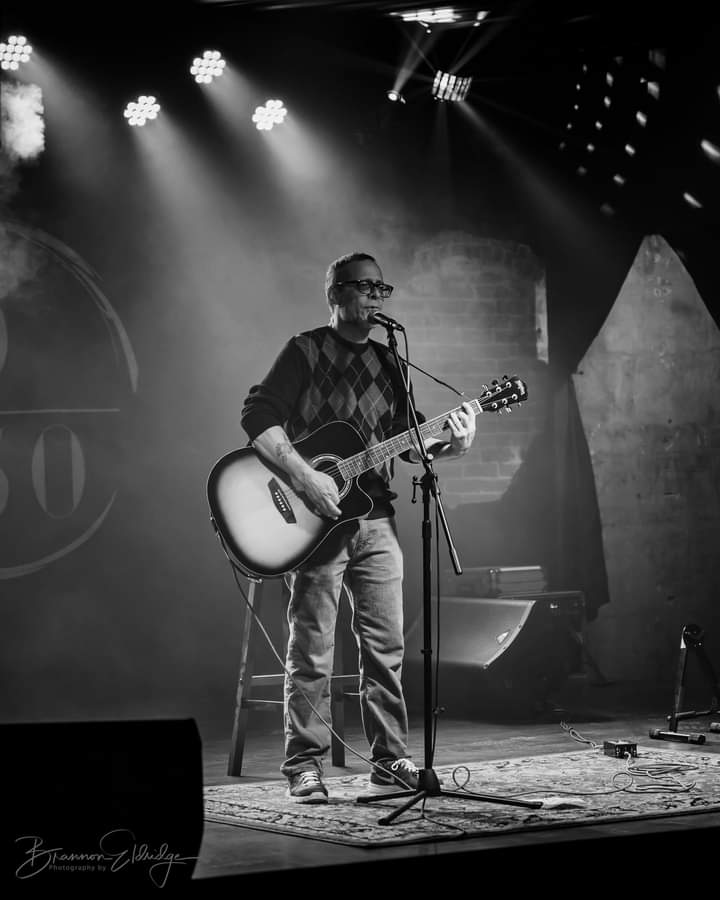
Danny the Fish
The drummer who turned down Nirvana reflects on a wild ride through punk, Hollywood, and fatherhood.
Danny the Fish has never lived life in half-measures — growing up in Tacoma during the late ’80s and early ’90s, he was swept into a music scene shedding cover bands for raw, original energy. While the underground exploded with punk, grunge, and experimental sounds, Danny found himself in the middle of it—playing in chaotic, drug-fueled bands, once even turning down an audition for Nirvana. From the Rhino Humpers’ notorious shows to Katie’s Dimples and Chaser, he earned a reputation for drumming with heart and fire. His path eventually led to Hollywood, where he toured with Keanu Reeves’ band Dog Star, worked in celebrity-packed clubs, and recorded with major producers. But the highs came with crushing lows: addiction, lawsuits, broken bands, and a violent assault that nearly killed him.
Seeking escape, Danny left the industry and settled in the Midwest, where his daughter’s serious health struggles reshaped his relationship with music. No longer about rebellion or adrenaline, it became a lifeline—his way of processing pain and connecting with her, as songs became her clearest form of communication. Today, Danny doesn’t play for fame. He plays for truth—for himself, for his daughter, and for the beauty that comes from imperfection. We sat down with him to talk about what it means to keep chasing authenticity when the world tries to wear you down.
Your musical journey is fascinating. Let’s start with your early years in Tacoma, WA. Growing up in the ’90s, how did the local scene influence your sound? What were some of the key moments or artists that shaped you during that time? When did you first understand that music was your passion?
Growing up in the late ’80s into the ’90s felt like a revolutionary period, not unlike the ’60s. Bars that were tired of paying ASCAP and BMI for cover bands started booking royalty-free original music. Mostly punk, but anything original played well.
At the same time, commercial music had gotten so predictable and soulless that people were clamoring for something new. That’s part of why I chose not to pursue a place in Nirvana. Honestly, grunge almost never happened—the death of the singer of Mother Love Bone changed everything.
You mentioned turning down Nirvana’s offer to try out for drums. That’s wild! What was going through your head at the time, and how do you feel about that decision now, looking back?
I liked Nirvana. I especially liked their drummer—hell, I loved the guy. I consider him an influence. He’s got a new band called Can of Clouds that’s pretty sweet, just like him.
For the record, I never met Kurt. I met Krist once, but it was just a quick hello.
Before I had any success with music, I played Metal/Punk/Junk in a band called Dead End. We were a meth-addicted hardcore group. So hardcore, in fact, that our singer shot my bass player in the head for drugs and money. He somehow survived, but the band was done—and I was done with hardcore punk.
I liked Nirvana, but their crowd overlapped with the hardcore scene. When I went to meet them at a show at the Motor Sports Garage—where Mudhoney’s drummer was filling in—I watched from backstage. The crowd was all angry dudes, and I felt like I wanted no part of that. Bad juju.
I was already in the Rhino Humpers and loving it. Do I regret my decision? Hell no! I love Dave! But honestly, I probably would have died from a drug overdose or ended up quitting anyway. Drugs were a real problem for me at the time.
That singer from Dead End—Leif Wolfe—was murdered execution-style in Tacoma not long after his attempted murder of my bassist. His case is still unsolved. I’m no longer in contact with any of those people.
Being part of the Rhino Humpers, you were right in the middle of the punk scene. How did that experience shape your approach to music, and what lessons from that era do you carry with you today?
The Rhinos actually opened for Nirvana on their first show. I wasn’t there, though. I had saved my show money to see a band called Sedated Souls, who were supporting Mother Love Bone at Legends, the all-ages club in Tacoma. I’d never heard of Mother Love Bone, but that night changed my life.
The Rhinos were super cool. A friend knew them and told me they were looking for a drummer. He set it up, and they reluctantly accepted me after a makeover and a good hazing.
The punks hated us, the glam dudes made fun of us, but we built a following with a heavily participating crowd. People knew our songs so well that we could literally leave the stage, get a beer, and smoke weed while our friends and fans played our songs.
I quit and rejoined the band a few times. They even wrote a song about me—I Know Daddyo (my nickname)—on their album Bro for Life.
Members of note included Donnie Hales (Donnie Paycheck), who became drummer of legendary punkers Zeke, and Jeff Rouse, who went on to play with Alien Sex Fiend and Duff McKagan’s band Loaded.
You mentioned moving to Hollywood with your band Katie’s Dimples/Chaser and living a kind of Almost Famous experience while touring with Keanu Reeves’ Dog Star. What were some of the highs and lows of that experience, and how did it impact your view of the music industry?
This is an almost unbelievable story—I can hardly believe it myself.
Katie’s Dimples was a cute acoustic punk band—super artsy-fartsy and completely original. I loved them and vowed to be their drummer. I basically pushed their original drummer out. He hated me for a while, but now we’re friends—he’s in a kick-ass band called The Fucking Eagles.
We blew up quickly and put out a few 7”s. Of course, I quit and rejoined the Rhinos for no good reason. Katie’s kept climbing, signing with Will Records, who immediately sold their entire catalog to Capitol. When their drummer quit, I rejoined.
We were eventually sold to Lakeshore Pictures, which is how we got the gig opening for Keanu Reeves’ band Dog Star. We drove 36 hours straight in our singer’s dad’s van to make it. Keanu was everything people say—kind, friendly, and respectful. They took us under their wing, especially me, and I’m still friends with them.
But behind the scenes, things got rough. We toured for over two years on just an EP, because our masters were being passed around and held hostage. At one point, we played 380 shows in one year. When members started quitting, the label forced us into a new name—Chaser.
We finally released a record produced by Don Was, but Will Records shelved us in favor of other bands. We stole our van and ran away to Hollywood. There, the original bassist rejoined, we recorded again, and I worked at a hip nightclub called The Opium Den, full of celebrities and drugs.
My drug problem got out of hand, and I was eventually kicked out of the band. Soon after, lawsuits and label wars broke the band up. Things got dark for me. I joined The Christian Smith Band, but life was in a lull.
Then I was attacked, beaten, and robbed one night—so badly they had to put my eyeball back in my head. That broke me for a while. I spiraled into drugs, got my equally drugged-out girlfriend pregnant, and tried to be a dad. That was the end of Hollywood for me.
After all of that, you took a step back from the industry and moved to the Midwest. What led you to make that shift, and how did you find balance and peace there before your life changed with your daughter’s diagnosis?
I didn’t just take a step back—I ran away. On a whim, I moved to Cape Girardeau, Missouri, to meet a girl I’d never even met. I tried to forget my old life and make music a hobby.
Your daughter’s health journey sounds incredibly difficult. How did that experience shape your music, and how did music become a tool for healing during those years?
My daughter’s health defined my life for the last 15 years. She sometimes had almost nonstop seizures, day and night. She never learned to talk and has significant disabilities.
Oddly enough, all she cares about is music. No cartoons, no dolls—just music. When she got her first tablet, she was in heaven. She mostly loves pop and female vocalists, but also Paul Simon, Johnny Cash, and lately Glass Animals.
Her mom left a few years ago, so now it’s just the two of us. She’s my biggest fan. She’s had brain surgery, and her seizures are better. She’s still nonverbal, kind of a mix of a 4-year-old and a teenager. It’s confusing, but we manage. I have helpers, and I still play local shows.
In terms of your sound, you blend a variety of genres—acoustic, heavy rock, R&B, classic country. How do you navigate those contrasts in your music, and what do you feel each of those genres brings to the table in terms of storytelling and emotion?
My taste is wide open. Since I’m not trying to impress anyone or get famous, I just do what I want. I make music for myself because I have to. It often feels like the song already exists somewhere inside me, and I’m just trying to translate it into human language.
There’s something deeply personal about your approach to music, especially with the minimal editing and all the instruments being played by you. What’s the significance of that DIY approach to you, and how does it connect to your personal story?
I believe in the cracked teacup theory—the imperfections make beauty more beautiful, more relatable, more tactile.
My friend is a great producer, but we always clash about quantizing and vocal tuning. I like the mistakes. I love the fluctuation, the slight drag or push of the beat. Coming from punk rock, I’d rather hear a shitty original than a half-ass cover any day.
You’ve lived through some intense personal and professional experiences. If you had to describe your music in one sentence, what would you say it represents or stands for?
I am my music.
You’ve mentioned smoking like Willie and driving like Steve McQueen—two icons with unique, rebellious personas. How do you identify with those figures, and in what ways do they influence your music and the life you’ve built around it?
Willie Nelson and Steve McQueen—legends of my father’s time. I’d also add John Fogerty and Johnny Cash.
I didn’t realize for the longest time how much these men influenced me to do better, to be loving and open. I’ve always connected them with personal freedom and the responsibility that comes with it.
My mom always said I was born in the wrong generation—that I was a hippie at heart. Maybe she was right.
Being a Pisces, you must have a lot of emotional depth. Do you find that your zodiac sign plays a role in how you connect with your music, or is that just a fun aspect of who you are?
Astrology is how I navigate my spiritual journey, which is very entwined with my music. Pisces is all over my chart—same as Kurt Cobain.
It gives me emotional depth and the willingness to expose my worst fears and flaws in a safe way. Pisces is a big part of my identity—it feels authentic and real.
Looking ahead, what are your hopes for the future of your music? What’s next for Danny the Fish, both personally and artistically?
Most of my energy is going toward my daughter—getting her ready for the world as best I can. My goal is to get her into an ISL house (independent supervised living).
At that point, I’d like to load up my little bus, hit the road, and play music for the rest of my life—while keeping tabs on Meadow and visiting. I think that would make her happy.
Finally, is there a message you want listeners to take away from your music, especially considering all you’ve been through and continue to go through?
Love yourself—especially your flaws. It’s good to be different.
Listen to Danny the Fish here.
About the Author