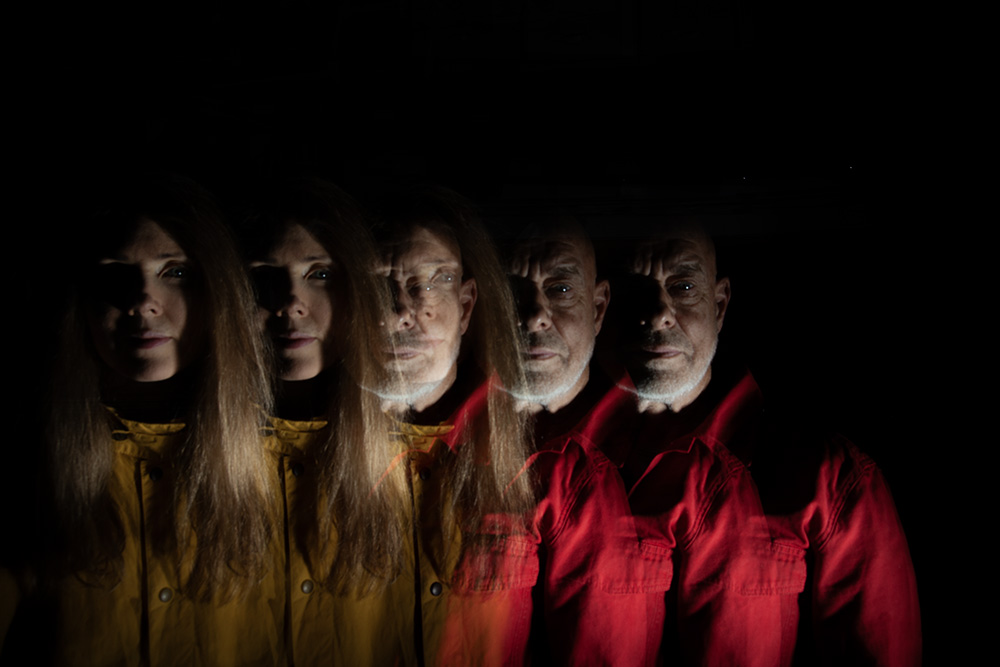
Brian Eno and Beatie Wolfe photographed by Cecily Eno
On October 15, Liminal travels through the Holmdel Horn antenna — the same instrument that once heard the birth of the universe.
Beatie Wolfe and Brian Eno have always looked at music as something larger than sound — something that breathes, evolves, and exists in conversation with the universe. Now, with their new collaborative album Liminal, the pair are taking that idea literally, beaming their work into outer space.
Out now on Verve Records, Liminal is the third chapter in a remarkable trilogy that includes Luminal (“dream music”) and Lateral (“space music”), both released earlier this year. But Liminal feels different — deeper, darker, and more mysterious — the artists call it “Dark Matter music,” a sound that exists in the space between and beyond.
“Liminal dwells somewhere between Lateral and Luminal, but also in its own place entirely,” Wolfe and Eno said in a joint statement. “It feels like the beginning of exploring a new terrain of music — future landscapes, environmental spaces, and atmospheres that a human presence (of sorts) occasionally floats in and out of.”
Despite the cosmic ambitions, the making of these albums was surprisingly humble — as the two told Billboard, their creative routine was simple: Wolfe would leave her London flat on her bike, ride through the park, and arrive ten minutes later at Eno’s studio. There, they’d hash out ideas on a guitar Eno bought in 1981. If they needed an instrument they didn’t have, they’d walk to a local pawn shop and pick one up. “There were no private jets,” Wolfe laughs.
Their latest single, “Procession,” released October 10 alongside a video by Orfeo Tagiuri, captures this duality perfectly. The song began as an experiment with Eno’s legendary Oblique Strategies cards. “It was always known to us as Tidy Up Inconsistencies,” Wolfe explains. “We each drew a card — one said ‘Tidy Up,’ the other said ‘The Inconsistency Principle.’ We didn’t tell each other what we’d drawn, but we let it shape the piece. That tension between order and disorder became the music.”
But Liminal isn’t confined to Earth — on October 15 at 6 p.m. ET, Wolfe and Eno will transmit the album into the cosmos using the historic Holmdel Horn antenna in New Jersey — the same device that Nobel laureates Robert Wilson and Arno Penzias used to detect the cosmic microwave background radiation, the faint echo of the Big Bang.
Dr. Wilson himself will join them for the event, which marks the first major broadcast from the newly dedicated Robert Wilson National Park. It’s a poetic convergence of science, sound, and spirit — and a full-circle moment for Wolfe, who first sent music into space back in 2017 with her Raw Space project, described by The New Yorker as “a new kind of album experience.”
For Eno, it’s a continuation of his life’s work: exploring how sound interacts with place, time, and perception. For Wolfe, it’s another leap into her long-standing mission to bridge the tangible and the intangible — a continuation of the ideas that have defined her career, from her environmental data visualizations to her award-winning Big Oil x Methane project.
The Liminal broadcast also follows a moment of powerful artistic activism. On September 17, Eno co-produced Together for Palestine, a benefit concert at London’s OVO Wembley Arena featuring musicians, actors, and advocates including Paul Weller — with Wolfe joining Eno’s ensemble on guitar.
Beyond its cosmic reach, Liminal is music for stillness — a quiet rebellion in today’s world. “So much information is just trying to cut above that constant noise,” Wolfe tells Billboard. “To make things quiet — but still voluminous — feels really needed right now.” Eno agrees: “There’s a flood of stuff hitting us all the time… I think art is one of the primary ways of saying, ‘Hold on, what do I actually like?”
If Liminal is about the spaces between worlds, then this collaboration embodies that same spirit: art, science, and activism orbiting in sync. With Liminal, he and Wolfe have built a vessel for time, space, and the infinite unknown.
About the Author