Being Human
Frontman Björn Norberg reflects on grief, melody, and the monsters within us all.
Swedish post-punk outfit Killing Kind return this fall with their second album, Being Human — a brooding, melodic exploration of grief, beauty, and the fractured state of the modern world. Building on the success of their 2023 debut, the Swedish trio push deeper into the shadows, blending darkwave synths, haunting melodies, and flashes of analog warmth to create a record that feels both intimate and cinematic. Produced by legendary Swedish producer Tomas Skogsberg (Entombed, Dismember), Being Human draws on influences from Depeche Mode, The Cure, and David Bowie, while carving out a sound uniquely its own — one that balances emotional rawness with striking artistic clarity. The album’s lead single, “Desperately Holding On,” has already garnered international airplay, hinting at the record’s central themes of endurance and fragility amid an age of chaos and decay.
Frontman Björn Norberg spoke with Indie Sound about the creative process behind Being Human, tracing his musical roots from early experiments with guitar to the layered synthscapes that define Killing Kind today. In a candid conversation, he reflects on the album’s darker tone, the band’s evolving chemistry, and how making music has become both a form of resistance and a way to process the world’s growing despair.
Indie Sound: How did you first get started making music? Can you remember the moment you knew you wanted to make music seriously?
Björn Norberg: I wanted to play drums but we lived in an apartment so it wasn’t possible to play at home. My parents had an acoustic guitar and suggested I should learn to play that instead. That’s how it all started. Then it took a long time before I realized I was able to write songs. I played in bands but I wasn’t the one who came up with the ideas then. I am still a bit amazed that I can write songs, and every time I come up with something I like, I am surprised. I can’t say I remember a certain moment when I understood that I wanted to work with music more seriously, it is something that has grown over time. Today I play almost any instrument, but not drums. I even suck at programming the drum machine! That is why some Killing Kind songs have some strange structure. It is due to bad programming on the demos, and then the drummer, Mats, decided to keep my mistakes.
Indie Sound: Who were your biggest musical influences growing up?
Björn Norberg: Bowie, Depeche Mode, and OMD, but I also listened a lot to metal. Anything that was dark and extreme. Always listened a lot to Pink Floyd as well.
Indie Sound: What usually sparks a song for you — lyrics, melody, or mood?
Björn Norberg: Melody comes first. I am a total sucker for melodies. Second is the mood, but that comes through melodies and sound. Lyrics I rarely care about; most lyrics are embarrassingly bad. I had an idea that Elvis Costello writes good lyrics, because he wrote Shipbuilding, which is the best song ever lyric-wise, so I read through like 20 of his songs. And even they sucked!
Indie Sound: Being Human feels darker than your debut, what was driving that shift in tone — was it intentional from the start, or did it evolve naturally during recording?
Björn Norberg: I believe I am getting better and better at writing beautiful but sad and dark melodies. But that is not so strange. Look around and see what the world looks like. It gets more and more depressing. I need to reflect that, to process it. And if I am sad, sad music is the cure. So not intentional, but the conditions of our contemporary times made it darker.
Indie Sound: Your music carries a strong sense of nostalgia, echoing the post-punk and synth sounds of the past. How do you balance those nostalgic elements with staying relevant as a modern artist?
Björn Norberg: I don’t reflect so much upon this. I listen a lot to music made between 1978 and 1983. I like the sounds, and when I write songs I use old synthesizers and an 808 drum machine. I like the old analogue sound. I wouldn’t say it is nostalgic though, I am not recreating past times, I just like the sounds. Then Mats, who plays drums, and Mats, who plays synthesizers (yes, they share the same name), record their instruments. They add some more contemporary sounds to it. Out goes the 808. Then I put everything together with Tomas Skogsberg, the producer, who is really old school. Then again — if the melody is strong, the sound doesn’t matter that much, I think. In my opinion, that is what is lacking in modern music — melody, good songs, and originality.
Indie Sound: You returned to record at Sunlight Studio with Tomas Skogsberg, a producer best known for Swedish death metal. What does his presence bring to Killing Kind’s sound?
Björn Norberg: Tomas is extremely good at guitars and drums. But on Being Human, there is very little guitar. But what few people know is that he is really good at old analogue synthesizers and he owns a bunch of them. So he understands what we are looking for. He was really into Twin Tribe when we were recording. But of course, there is a heaviness that he brings in. But mainly I like to work with him. He is essential when it comes to the recording of the vocals. I need him as a coach; he always asks for another take, pushing me. Some of the tracks I recorded the vocals in three or four different octaves. I would never have thought of that, pushing myself in that direction.
Indie Sound: Can you describe the recording atmosphere at Sunlight Studio? There’s a certain mythology around that place — did you feel it shaping the album’s energy?
Björn Norberg: It is situated in the countryside, a small hut in a forest. You live there while you work with the recordings, and it offers a bubble where you do not have to think about anything else but the music. You work day, you work night — with full focus on the music. Of course, you see all the big records he has produced, they are on the walls of the studio, plus loads of memorabilia from all the bands. I think it’s a cozy place. The gear that made the studio what it is is still there and in use. You know, the HM2 pedal, the Sect console, the old Peavey Bandit, the DS1 distortion that we run directly to the console. It’s not magic but very Sunlight.
Indie Sound: How did the collaboration between you, Mats Wigerdal, and Mats Molund evolve since the first album? Has the dynamic changed now that Killing Kind has become a full-fledged band rather than a side project?
Björn Norberg: Not really changed much. We never rehearse. We send files to each other. Wigerdal will call me now and then. Molund texts me a lot. The difference with this album was that many songs were written on synthesizers or piano. And the keys were on the demos I sent to them. I guess that created some problems for Wigerdal. He needed to delete what I had done to add something else, without being too influenced by the demo synths. It is easier for Molund since I always use the 808.
Indie Sound: The album’s title — Being Human — suggests a kind of existential reflection. What does it mean to you personally?
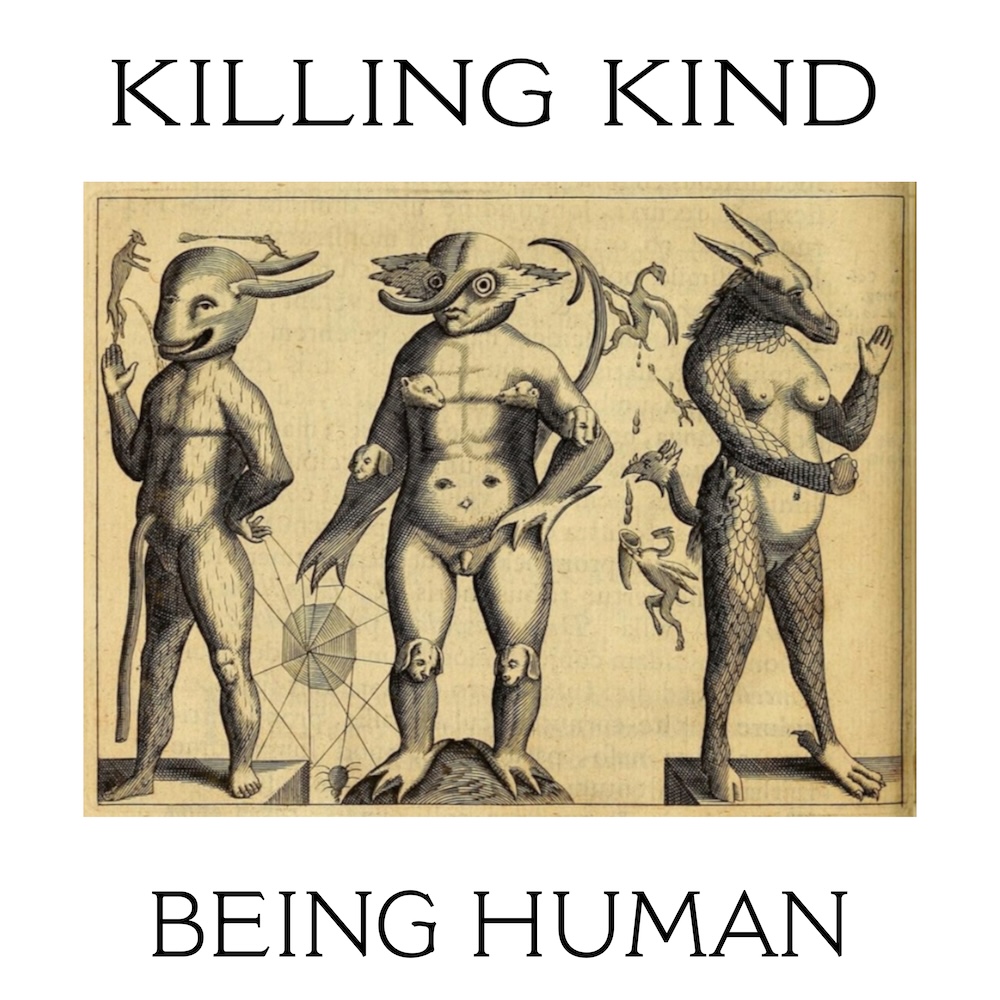
Björn Norberg: It started with the song Humanity where I play around with the words “humanity” and “insanity.” At the time I was working on the song, I visited a museum of medical history and they had these fantastic prints from the 17th century depicting monsters. I took some photos of them with my cell phone, and one was later used for the album cover. I saw the monsters as an image of the human being. We are the real monsters of the world. The album title came later, I just moved the words around, “human being” became Being Human. Since the album is dark and depicts the current state of the world, the title opens up for many interpretations, which allows you to reflect and think. If we had called it Human Monster, that wouldn’t really have been possible.
Indie Sound: The press notes mention “incantations and chants for a dying world.” Do you see the album as a kind of spiritual or emotional response to global chaos?
Björn Norberg: Yes, very much. But I don’t know if I want to describe the chaos I see or if this, writing music about a world falling apart, is some kind of therapy for myself first and foremost.
Indie Sound: Your lyrics often draw from sci-fi and horror imagery. What attracts you to those genres as ways of expressing real-world anxiety and trauma?
Björn Norberg: I see loads of horror movies and I read some sci-fi, so this is close to me. These genres have always been shown to reflect global traumas. During the Cold War, there were a lot of films about alien invasions. In our current times, the climate fiction has developed. And the sci-fi around the colonization of Mars. Horror movies can be about an outer threat as well. Also, I pick up lines here and there, or just moods, from films I see or books I read. So yes, the fiction is always about reality in some way. Even when we deal with vampires or aliens.
Indie Sound: Songs like Desperately Holding On and Let the Demons Take the Win suggest both defiance and surrender. How do you balance hope and despair in your songwriting?
Björn Norberg: Hmm. Never thought of it in that way. I have no solutions, so I don’t know about hope. Let the Demons Take the Win is about using art and music to describe the darkness. An artist can let the demons take the win and still have an important message. Look at black metal bands and goth bands, for example. It is a way to use the evil as an incantation to overcome the evil. There is not very much hope in Desperately Holding On, I am afraid. We are holding on to unsustainability and are unable to change, even if everything is dying. The only way out in the end is to send out a space ark to let humanity settle somewhere else.
Indie Sound: If the debut Killing Kind was about discovering your identity as a band, what story does Being Human tell about where you are now?
Björn Norberg: The first album was very much a reaction to the pandemic situation, where we for different reasons were forced to put my other band Quantum Leap on hold. One night I saw a post from Mats Molund in a post-punk group. I knew him a bit and I said, hey, we should make some music together. I wanted to make something more synth-based than Quantum Leap, and the pandemic was the perfect time for it. Being Human is a step forward with even fewer guitars. Also, we need to start working as a live act and have some concerts coming up. We will see how that works — it means some lineup changes. I can’t play synths, guitar, bass, and sing at the same time!
Indie Sound: How do you fuse the cold minimalism of early post-punk with the emotional depth and melodic sensibility of modern synth-pop?
Björn Norberg: Never thought of that. Take a band like Joy Division. My favorites from their catalogue have always been the more melodic ones. On the other hand, my favorite Manchester band from that period is A Certain Ratio, who sounds like a very cold and monotonous Joy Division playing samba. There are just glimpses of melodies in their music. But you know, a parrot would be very visible if released in Manchester! If I were to analyze Being Human, I would say that the melodies always come first, but on the other hand, it is often so that I start with a new synth sound and that gives the melody. It goes hand in hand and cannot be separated really. Also, I can play most of the songs on an acoustic guitar, and they will still be old-school post-punk. So it is again back to the melodies. It seems there is just one way of doing things, the result will always be the same. There seems not to be any outspoken method on how to fuse things. It will all come out the same every time.
Indie Sound: You’ve worked across multiple genres, including electronic and experimental music. What lessons from those earlier projects did you bring into Being Human?
Björn Norberg: When I was young I played a lot of riff-based music, and when I work with guitar, I always center around a good riff that becomes the hook of the song. There are several of these on Being Human. Since I have been working a lot with more experimental music, mainly curating concerts and performances within the noise and EAM scene, I am not afraid to experiment a bit in that direction. There are some Bowie, Scott Walker, and Robert Fripp influences I guess that shine through here and there. If we have time and the possibility, I would like to explore that further, without stopping to make short and concrete songs.
Indie Sound: The album title Being Human feels timely — especially in an era of AI, social fragmentation, and environmental crisis. What does “being human” mean to you in 2025?
Björn Norberg: Too often it means being a monster. The AI simply mimics the human being, and that is why AI is mean. We are the real monsters. At the same time, being human might implicate being respectful. There is a nice, idealistic idea around the concept of humanity. So being human is very dual, or it contains many facets. Good or evil doesn’t really cover it all. The title is meant to start generating thoughts and it will ask you to make statements, at least for your yourself. I think that is one of the main tasks for art — to make people think and reflect. If you do so, you can possibly contribute to a better world. And individual thinking is important for sustainable democracies. That is why anyone in power will always be afraid of artists. Art will ask people to question the current conditions.
Indie Sound: Do you see Killing Kind’s music as a form of resistance — emotional, artistic, or even political?
Björn Norberg: Yes, definitely. But it is also a way for myself to digest the world around me. If this means others will do the same, that’s even better. So political, definitely. Emotional — I think so. Artistic — I don’t really know. I mean listen to any of Scott Walker’s albums from Climate of the Hunter and on. They represent resistance and integrity!
Indie Sound: If you could sum up Being Human in one image or feeling, what would it be?
Björn Norberg: Grief. A grief over what should be beautiful is soon destroyed.
Indie Sound: Killing Kind has grown from a studio project into a live band. How have the songs evolved in performance?
Björn Norberg: We have played live as a duo — drum machine, bass + me on vocals and guitars. It is a bit like Twin Tribes, and it works, and means we can play smaller clubs easily. And what is good is that the songs are very much recognizable but still different from the recorded ones. Who wants to see playback shows or a band that sounds exactly like the record? At the moment we are working on ways to integrate live synths and drums. I think that will be important, otherwise, we need to look at other ways of creating something visual. Bands such as Kite have been very good at this. But that is more like a vision some years ahead, I think.
Indie Sound: How does the audience’s response shape your relationship with these dark and introspective songs?
Björn Norberg: Music is a way to communicate. When you get a response, it starts up a two-way communication. Monologues are a bit boring in the end! And I really think we need the darkness, it appeals to many people in a good way. I can understand that people also want to interact by dancing. Maybe we can offer some dance on our next record! We will see… However, I never dance. So I am fine if the audience stands still looking gloomy as long as we can communicate in other ways. We can talk, write, send images…
Indie Sound: You’re already working on a third album — how does it build on or diverge from Being Human?
Björn Norberg: It is a bit more synth-based since only a few of the songs have guitars at the moment. However, we are just finishing the drums on 15 or 16 songs and 10 of them will end up on the record. The plan is to finish it in February. So far, it is close to Being Human, just a bit more Depeche than Bowie maybe. Many things can change still.
Indie Sound: The album releases on October 31 — Halloween. Was that coincidence or perfect symbolism?
Björn Norberg: The date was a suggestion from the record company. We saw that the calendar was empty that day, so we said yes. Then I contacted a record store where we were supposed to sign the record and make a store gig. And they said “ehhh, not a very good date for us, you know, it is a holiday and we’re closed”! Then I understood it was Halloween. So just a coincidence and no smart planning! We will make the record store thing later on still.
About the Author