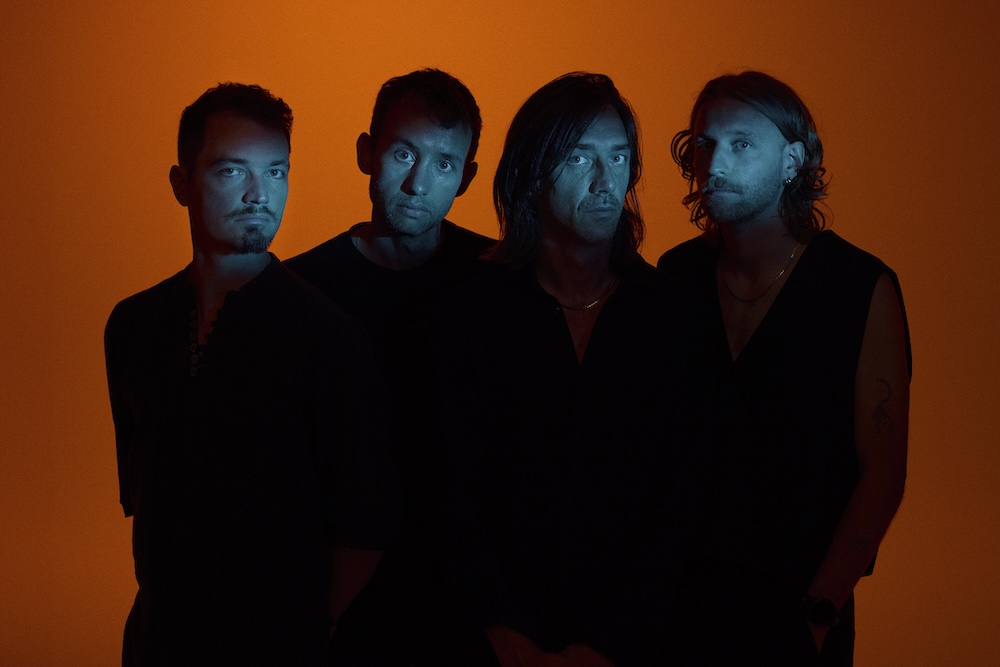
Stavroz photographed by Alexander Popelier
With their unmistakable fusion of acoustic instrumentation and electronic pulse, Belgian quartet Stavroz have carved out a singular space in contemporary music. What began as a group of friends DJing in East Flanders has grown into one of Europe’s most distinctive sonic collectives, known for crafting immersive, cinematic soundscapes that live somewhere between dancefloor energy and quiet introspection. Across their releases — from the acclaimed debut Mindibu (2022) to last year’s Kick Up The Dust EP — Stavroz have blurred the boundaries between the organic and the synthetic, weaving textures from around the world into compositions that are both tactile and timeless. Their new album, Take a Seat, marks another bold step forward: a 14-track exploration of rhythm and reflection that asks listeners to slow down, take a breath, and experience sound as both movement and meditation.
At the emotional core of the record lies “Lilac”, a haunting collaboration with RY X, accompanied by a striking visual directed by Toon Persyn. The film captures the song’s meditative exploration of memory, loss, and time through a child’s eyes — blending melancholy and transcendence in equal measure. In this exclusive interview, Stavroz and Persyn discuss how their visions intertwined, the unpredictable moments that shaped the video, and how Lilac became one of the band’s most poignant and poetic works to date.
The video for “Lilac” powerfully explores themes of time, loss, and memory through a child’s perspective. How did the concept evolve with the band, and what was your vision for translating the song’s emotional weight into a visual narrative?
Toon Persyn: Gert came to me with the initial idea for a music video about a kid who was stuck on something. What that “something” was, was open for discussion, so we both started writing scripts about what that could be. We came up with two different ideas and pitched them to Ijsbrand and Maxim. They liked parts of both, but neither fully fit the song’s melancholy. So we combined the elements we loved and built something new together. The result explores how once something is gone, you can never get it back — and how childhood memories, meant to be carefree, pass too quickly. That fleetingness adds enormous emotional weight to the story.
The shoot faced unexpected challenges like heavy rain and cast changes, yet the result feels seamless and cinematic. How did those unpredictable moments shape the final film?
Toon Persyn: Halfway through the shoot, it started raining cats and dogs — just as we finished interiors and were about to film exteriors. To make things worse, one of the actresses had a medical emergency and had to leave, taking her daughter and mother (who were also in the film) with her. So we postponed the shoot to the next day. Gert called other people who had applied for the roles — luckily, they were still available. The next morning, the sun was shining bright, and everything fell perfectly into place.
Your journey started in Flanders as a group of friends experimenting with DJ sets and electronic music. How has your sound evolved since those early days?
Stavroz: We grew older, and with that, our tastes changed — so naturally, the music did too. It might have become a bit more serious, less playful… and maybe even a little more boring. But in a good way, I suppose.
What drew you to collaborate with RY X on “Lilac”? How did the songwriting and production process differ from your usual workflow?
Stavroz: Our music tends to be quite delicate and intricate — we’re always chasing a fragile balance between organic emotion and electronic sound. RY X is one of the few artists who masters that same balance. He brings tenderness and gentleness to a genre that can often be too “in your face.” It just made sense.
During brainstorming for the video, you mentioned ideas like “a kid who felt stuck” and “a cookie-cutter neighborhood.” What resonated with you about these images?
Stavroz: It’s about the frustration of missed opportunities — the inevitability of life as it unfolds. We age, yet somehow we don’t feel older. The only way to notice time passing is through repetition: seeing the same things again and again. That’s why we imagined the identical neighborhood — everything looking the same, everything happening the same. It’s both familiar and quietly suffocating.
How did the unpredictability of the shoot mirror the mood of the song itself?
Stavroz: Quite perfectly, actually. We had to reschedule the shoot halfway through. Coincidentally, RY sings “if I could do it again.” It was an unplanned parallel — kind of poetic, and also pretty funny.
What was the most memorable or challenging moment during the making of “Lilac”?
Stavroz: Hearing the first draft from RY, with his vocals on it. The whole band was together when we played it, and we all just looked at each other, smiling. He somehow lifted the track to another level – it was one of those rare, collective moments of joy and surprise.
How does this collaboration fit into Stavroz’s artistic journey – and what can fans expect from you next?
Stavroz: It fits naturally, because we share a similar philosophy towards electronic music. So it’s not really a detour — more like another facet of who we are. As for what’s next… we don’t really know yet. Our focus was on finishing the album — it’s there now, it exists, maybe forever. We’ll see what the next year brings, and what new adventures or challenges cross our path.
How did your individual visions align to create the world of “Lilac”?
Stavroz & Toon: We spent a few hours on the phone, just talking – trying to put into words what the song meant to each of us. From there, we started shaping how we could express that visually, without involving any of the band members on screen. It was about finding a story that reflected the song’s emotion, rather than illustrating it too literally.
Was there a particular moment during the process when everything “clicked” creatively?
Stavroz & Toon: Yes, during the final call about the script. That’s when everything suddenly fell into place: the protagonist, the storyline, the atmosphere. What started as a bunch of scattered ideas and intentions quickly got thrown overboard once we found the real thread. Every potential lead anyone was holding onto just dissolved, and what was left felt right.
How important was it for each of you that the visual and musical elements tell a unified story?
Stavroz & Toon: That’s always the goal, though the definition of “unified” can differ. There’s a special satisfaction when something just fits – when it feels coherent without being too obvious. Sometimes it can even seem like it doesn’t make sense at all, and that’s fine – as long as it makes sense to the people creating it.
What does “Lilac” represent to you now that the song and video are out in the world?
Stavroz & Toon: It feels like a proud moment — a small testament to what’s possible when collaboration works. It’s also a reminder that the music industry isn’t just about numbers and money; it’s still about trying to make something beautiful, something that moves people.
If you could describe the essence of “Lilac” in just one word, what would it be – and why?
Stavroz & Toon: Antidepressant. Even though the song carries a melancholic tone and deals with themes of regret, it somehow lifts me up. It’s fascinating how listening to sad music when you’re sad can make you feel better. You’d think happy music would do that, but it’s the melancholic ones that truly pull you out of the hole.
Take a Seat is now available on all platforms.
Buy the new album on Bandcamp.
About the Author