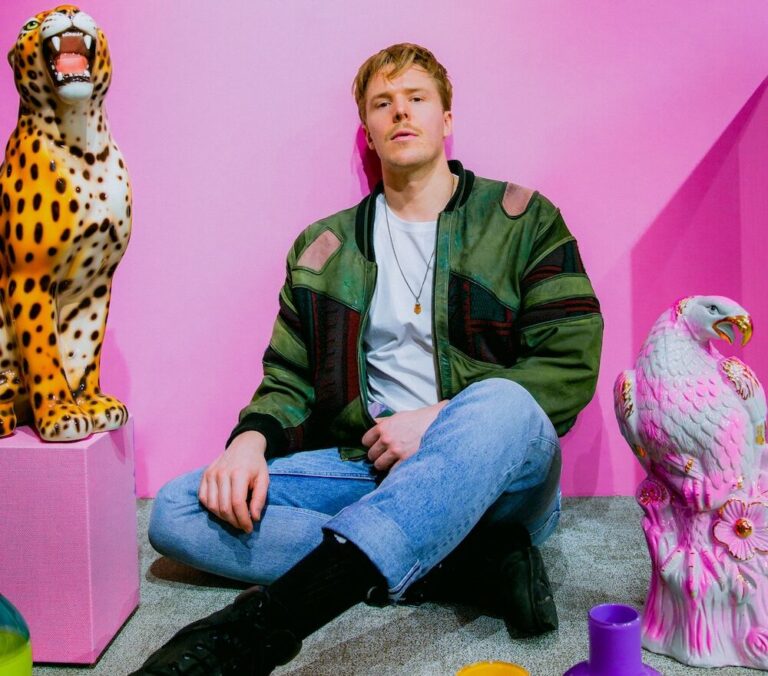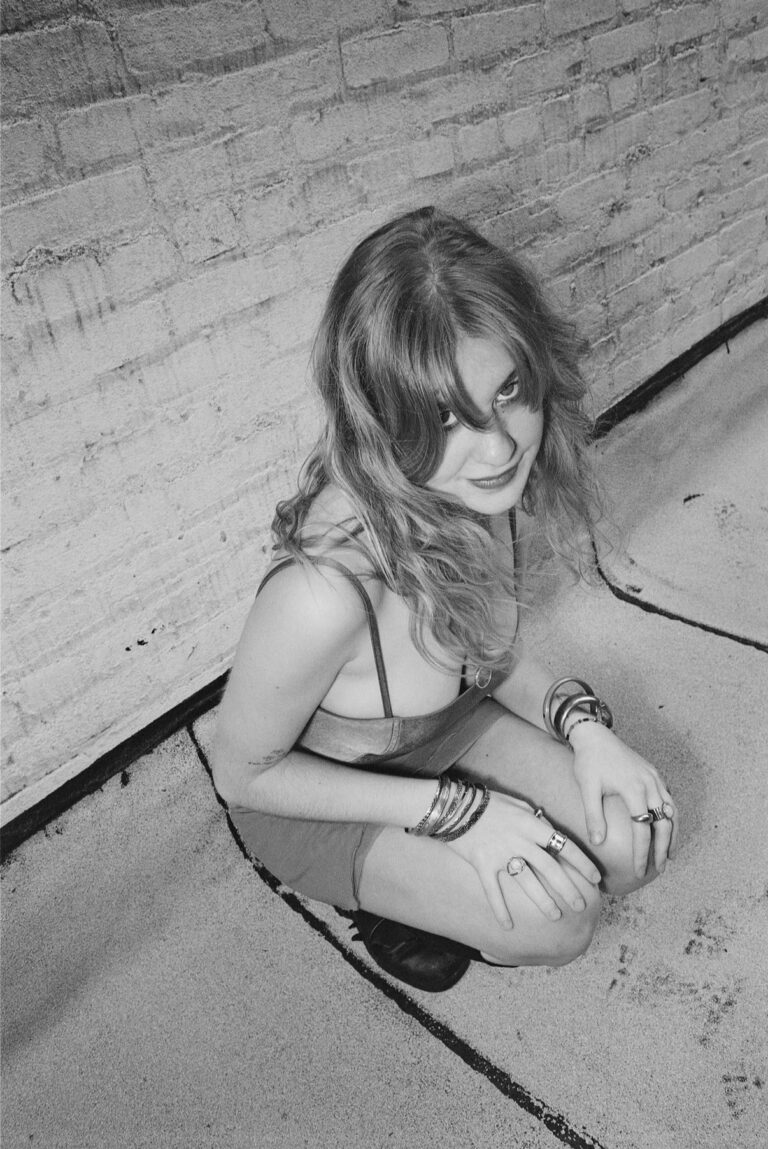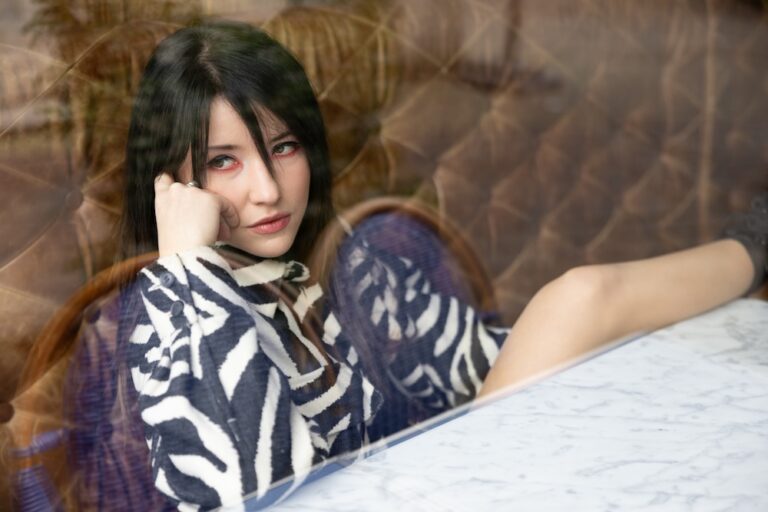
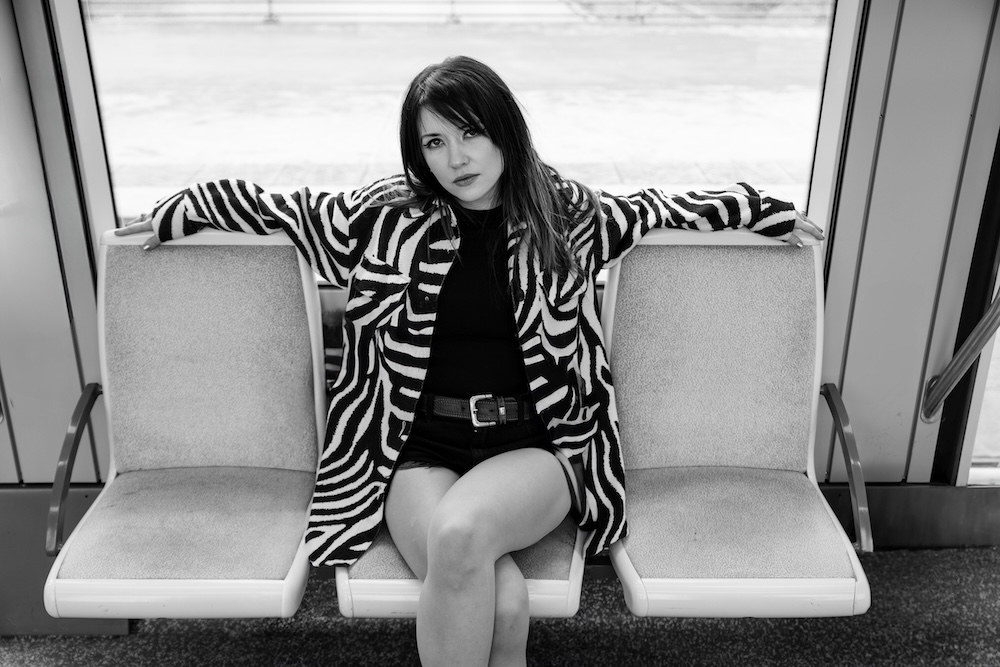
DORRR photographed by Marion Fort
For our latest feature, Indie Sound Magazine sits down with DORRR, an artist whose trajectory feels less like a traditional career path and more like an evocative, cross-continental road trip. From her childhood in post-communist Poland to her transformative move to France at 19, and her years fronting the surf-rock energy of The Blind Suns, Dorota Kuszewska has always been a nomad of both geography and genre. Now, stepping out from behind the guitar and into a rawer, more minimal electronic landscape, she is shedding the “dream-pop haze” of her past to embrace a sound that is as visceral as it is cinematic. It’s a metamorphosis born of both burnout and breakthrough, marking the arrival of a solo identity that is finally, and firmly, her own.
At the heart of this new chapter is her upcoming EP, GANBARU (set for release on February 27, 2026), a title borrowed from a Japanese concept that translates to “standing firm” or “enduring” through the struggle. In this interview, DORRR peels back the layers of that “fragile resilience,” discussing how she balanced the vulnerability of her lyrics with the discipline required to navigate the music industry independently. From the “chiaroscuro” production of her new tracks to the symbolic ritual of covering The Kills’ “Black Balloon,” we explore the mindset of an artist who has stopped chasing trends to focus on the honest, often “weird,” and deeply personal truth of the process itself.
What was your first real introduction to the world of music production?
I started writing my own songs when I moved to France at 19. It was a transformative time, and songwriting became my way of processing everything.
Together with my boyfriend, I taught myself how to use digital recording tools. Over time, we became confident with the DAW (especially him — laughs), which gave us something crucial: independence. It allowed us to shape our own sound and produce our projects on our own terms.
You’ve lived and worked in Poland and France, and you have strong ties to the UK music scene. How do these different cultures and landscapes bleed into the “cinematic atmospheres” you create in your music?
I grew up in post-communist Poland, at a time when the country was turning strongly toward the West for inspiration — culturally, politically, and musically. I remember the radio being filled with English-speaking artists. I think I unconsciously developed a natural need to write and sing in English. It felt instinctive. And of course, many of the most influential bands in modern music history come from the UK. So let’s say I felt reassured in that choice.
I’ve always been drawn to the countries where my musical inspirations came from. In a way, I cultivated a nostalgic dream of other places (landscapes I hadn’t yet seen), but somehow already felt connected to. Travelling reinforced that feeling. That longing, that emotional distance, probably feeds directly into the cinematic quality of my music. There’s often a sense of movement, of wide horizons, of emotional space.
Interestingly, growing up in Poland and later living in France didn’t consciously influence my artistic choices at first. I was always looking outward. But as I get older, I feel a stronger need to reconnect with my roots. There’s something about memory, identity, and the landscapes of childhood that slowly finds its way back into the music — perhaps in subtler ways, in textures, in moods, in a certain kind of introspective melancholy.
The Japanese concept of ganbaru often implies “standing firm” or”doing your best.” What was the specific moment in your life where you realized this word described your journey better than any English or Polish equivalent?
I don’t think there’s a word in Polish or English that fully captures what ganbaru expresses. It’s not just about doing your best: it’s about endurance, resilience, and showing up even when things feel difficult.
I discovered the concept during a challenging period in my life, when I was struggling with doubt and the temptation to give up after my band split up. I read once about Japanese techniques to overpower laziness and lack of motivation. Ganbaru stayed with me. It became a quiet reminder to keep going, to stay committed, even when progress feels slow. In many ways, it reflects my artistic journey — persistence over time.
You’ve described this EP as exploring resilience at its most “fragile.” How do you balance showing vulnerability in your lyrics while maintaining the strength required to “persevere” in the music industry?
I think vulnerability and strength are not opposites; they actually depend on each other. For me, writing about fragile moments is already an act of strength. It means I’ve survived them, or at least learned how to look at them honestly.
In my lyrics, I allow myself to be transparent about doubt, fear, or uncertainty. But musically (and professionally) I’ve learned that perseverance requires discipline and patience. The industry can be unpredictable, and you need a certain inner stability to continue creating without constant validation.
So the balance comes naturally: the songs hold the emotional fragility, while my mindset holds the resilience. Being vulnerable in my art doesn’t make me weaker. It reminds me why I keep going.
You mentioned Ganbaru is about committing without the promise of a happy ending. How does that mindset change the way you approach songwriting and the “success” of a record?
Ganbaru shifts my perspective completely. If you commit without expecting a guaranteed happy ending, you focus on the process rather than the outcome. Songwriting becomes an act of honesty and dedication, not a strategy for success.
Of course, every artist hopes their record will connect with people. But I’ve learned that tying your motivation only to results — streams, reviews, recognition — can be dangerous. That kind of expectation can paralyze creativity.
With a ganbaru mindset, I try to approach each song as something I have to give my full sincerity to, regardless of what happens next. The “success” of a record, for me, is first about whether I stayed true to the emotion and carried it through to the end. Everything else becomes secondary.
Moving away from the dream-pop haze of Glitch and Glitter and the surf-rock of The Blind Suns is a bold shift. Was there a specific song on this EP that acted as the “bridge” between your old sound and this new, minimal electronic style?
I think “What’s Going On” might be that bridge. It naturally blends organic instruments with the more minimal electronic direction I wanted to explore for this new chapter of DORRR.
The vocals still carry that dreamy, almost hypnotic quality, and there’s an oneiric atmosphere running through the track. At the same time, there’s something rawer and more grounded in the production — a subtle tension between softness and edge.
In that sense, the song feels like a transition point: it holds traces of my past sound while quietly opening the door to a more stripped-down, electronic identity.
You mentioned putting the guitar down to step fully into your role as a lead singer. How did that physical change—not having an instrument to “hide” behind—affect your vocal performance on tracks like What’s Going On?
I’ve always considered myself a singer first. I actually picked up the guitar quite late, when I started playing with The Blind Suns. So being on stage without it feels very natural to me.
Not having an instrument to “hide” behind allows me to fully focus on my voice and on physical expression. It creates a more direct connection — with the audience, but also with myself. To be honest, I feel freer without the guitar; it’s almost a relief (laughs).
That said, I’m not abandoning it completely. I’m planning to add a few live chords on certain tracks. But now it feels like a choice, not a shield.
What did the production process with Moon Pilot bring to the table that helped you achieve that “cinematic yet stripped-back” atmosphere you were looking for?
Working with Moon Pilot brought clarity and restraint to the process. I tend to be drawn to atmosphere and emotion, sometimes in a very instinctive way, and he helped shape that into something more focused and intentional.
We shared the desire to create something cinematic, but without overproducing it. Instead of layering endlessly, we concentrated on space — allowing the arrangements to breathe, letting silence and minimal elements carry tension. That’s where the “stripped-back” feeling comes from.
He also brought a fresh perspective to the electronic textures, helping them feel immersive but not overwhelming. The result is a balance between intimacy and scale — something that feels both personal and wide-screen at the same time.
The Scenius remix of Lonely Sun highlights women’s need for recognition. Why was it important to you to include this rework as a bookend to the EP, and what do you feel their “dark-pop” signature adds to the message?
I’m truly happy about this collaboration with Scenius. The remix actually happened quite spontaneously! We met after one of their shows I attended, and I was immediately drawn to their dark-pop energy and strong stage presence. It felt natural to imagine “Lonely Sun” through their sonic lens.
Scenius brought a darker, more pulsating intensity to the track. Their signature sound adds tension and urgency — it transforms the song from something introspective into something more assertive, almost confrontational. That shift strengthens the message around visibility and recognition, especially from a female perspective.
Ending the EP with that version felt symbolic: moving from vulnerability toward empowerment, without losing the emotional core.
10. The track I Might Be Weird celebrates “difference as a strength.” In an industry that often rewards trends, how do you protect your “weirdness” and keep your creative output honest?
I think protecting your “weirdness” starts with accepting it yourself. For a long time, I wondered whether parts of my sensitivity or artistic choices were “too much” or “not enough.” But I’ve learned that what feels different is usually what feels most authentic.
The industry often rewards trends, and it’s tempting to adapt. But trends fade. Identity doesn’t. If I create from comparison, I lose the emotional truth behind the music.
I Might Be Weird is my quiet manifesto: a reminder that difference isn’t something to smooth out, but something to stand on. Staying a little weird is how I stay honest.
Black Balloon is a very distinctive track. Why did you choose to cover this specific song as your “reconciliatory farewell to an inner struggle »?
I’m a huge fan of The Kills, and when I was looking for a song to cover for this EP, “Black Balloon” immediately came to mind. It’s a deeply symbolic track for me — I was obsessed with it in my younger years.
To me, the song is about releasing a burden, leaving the past where it belongs, and choosing to move forward. And that’s exactly where I found myself during the creation of this EP. I was breaking away from my past — both professionally and personally — making space for something new.
Covering it felt like a quiet ritual. In that sense, it became a reconciliatory farewell: not a dramatic ending, but a moment of acceptance — acknowledging the struggle, honoring it, and then letting it go.
You spoke candidly about feeling “empty” after The Blind Suns split. What was the first “event” or moment that made you realize the spark wasn’t actually gone, just changing shape?
I think it was a combination of the right people appearing at the right time, and unexpected opportunities opening up around me. I had gone through a kind of burnout, and for a while I truly felt empty. Then a new challenge appeared on the horizon. I chose to see it as a sign — almost like the universe testing me.
I realized I couldn’t refuse to try again. I’m not a quitter (laughs). Something in me woke up — a kind of warrior spirit. I felt the need to prove to myself that I was still capable of creating on my own, that I could exist as an artist independently.
It was terrifying to imagine carrying everything by myself this time, but that fear also meant it mattered. And that’s when I understood the spark wasn’t gone — it was just transforming.
From Poland to Nantes, and with support from UK-based Anara Publishing, you are a truly international artist. How does this “nomadic” background influence the “inner road trip” themes found in your music?
I’ve never really felt rooted in just one place. Moving from Poland to France, building connections with other countries — that constant movement shaped not only my life, but also my inner landscape.
Being “nomadic” created a permanent sense of transition in me. Even when I’m physically still, there’s always this feeling of crossing something — a border, a memory, a version of myself. I think that’s where the “inner road trip” in my music comes from. It’s less about geography and more about emotional displacement and transformation.
Travelling between cultures also gave me a certain distance from each one. That distance creates space — and space is essential in my music. It allows reflection, nostalgia, projection. My songs often feel like journeys because, in many ways, I’ve always been on one.
Having participated in the Keychange programme, how do you see the landscape for gender equality in the indie scene changing since 2019, and what role do you hope your music plays in that conversation?
Since 2019, I do feel there has been real progress in the conversation around gender equality in the indie scene. The topic is more visible, more openly discussed, and initiatives like Keychange have helped shift the narrative from awareness to concrete action. Line-ups are becoming more balanced, and there’s more space for women and gender-diverse artists to take leadership roles — not just on stage, but behind the scenes as well.
That said, there’s still work to do. Structural habits don’t disappear overnight, and representation doesn’t automatically mean equal conditions.
As for my role, I don’t see my music as a slogan, but as a presence. Simply existing, creating independently, producing my own work, and speaking openly about resilience and identity is already part of the conversation. If my music can encourage someone to claim their space without shrinking themselves, then I feel I’m contributing in a meaningful way.
You’ve said this EP opens up new paths for what comes next. Now that you’ve mastered the “minimal and visceral” form of Ganbaru, what is the next boundary you are excited to push?
If Ganbaru was about standing firm, what comes next is about motion. I want to take this music beyond the studio — to travel with it, to let it evolve on stage, to test it in different spaces and cities. The next boundary isn’t only sonic, it’s about presence, scale, and crossing physical borders as well.
About the Author