Parco Lee
The W and E actor-musician reflects on desert shoots, doppelgänger duels and his unexpected road to the silver screen.
Parco Lee’s artistic path unfolded through a series of unexpected turns; after leaving his previous career, he started with basic vocal training, but a chance partnership with a songwriter friend pulled him into composing, arranging, and the soulful blend of jazz, R&B, funk, and other styles that now shape his sound. Along the way, he learned from American musicians, a BBC-trained sound engineer, and a Taiwanese mentor who shared his passion for fusing contemporary genres with classical traditions.
In recent years, Lee has extended his artistry into acting, with roles in Anna Eriksson’s experimental films W and E. The latter inspired his latest standalone release, The Dunes of Void, composed after an intense desert shoot in which he played both a character and his doppelgänger. Though the track didn’t make the final cut of the film, it channels its atmosphere and emotional weight, shaped by the memory of sand, wind, and shifting horizons.
Can you tell us about your musical beginnings—what first drew you to composing and performing?
I first learnt singing 2 years after I left my previous career, but they only taught me basic vocal music. Next year I happened to know a friend who wrote and arranged songs. What we proposed to do is that he would write the songs and I would sing them, but it turned out I unexpectedly learnt lots of composing and arranging skills from him, as well as all relevant musical theories and knowledge. The next few years I happened to know some American friends online to teach me generic musical knowledge including composing and arrangement, and we unexpectedly became like masters and the apprentice. My musical genres were mostly shaped into the types of soul, jazz, R&B, funk, and any similar genres. Later, I was hired by a group of guys who wanted to find a place for playing and recording some music if necessary. I used to work for a senior sound engineer (he’s also a professional cameraman) who also worked for the BBC. So, I decided to visit him and his place and see what we would have to set up and do. He helped us out straight away, but that project was cut off prematurely. That senior sound engineer taught me everything he knows instead, like a master and an apprentice again. I got my own gears going, and started doing engineering works like editing, mixing and mastering myself. Years later there’s actually another Taiwanese musical teacher who writes and teaches exactly the same genres as mine. He taught me lots of high-level musical knowledge, we talked a lot, and sometimes even looked into classical music.
You’ve since expanded into acting, appearing in both of Anna Eriksson’s films, W and E. How did that transition from music to acting come about?
I was cast in a few TV series and TV commercials before I first met Anna. I forget if I was also cast in a film, but all of them were unexpected, unlike music. Some friends asked me if I would like to take that role, as I recall. I can’t remember further details like how did I know them, as that happened ages ago. But Anna found me through Facebook, she told me that she watched some of my videos before, and so decided to cast me. Honestly, at first, I suspected if it was just a scam pretending a star that happens all of the time, until we first met in North Point. We filmed a few scenes there and they’re supposed to be used in W, but they ended up not using them. All the scenes in W were filmed in Finland.
Do you feel there’s a shared creative impulse behind your work in both music and film, or do they satisfy different parts of you?
Both allow me to express my mood and emotions well, as well as help me explore different new possibilities. Although it depends on what types of music and film, normally my music world contains more music that’s closer to daily reality and films are more fictitious, despite all of the connections they have with things that happened in reality. Also, music is more than art; it requires other specialized skills like sense of rhythm, sense of pitch, and sometimes even about how much you can read from the sounds, with acoustic physics involved. Besides, music isn’t my only work or interest, but also a sovereign remedy for my head that’s healing my soul. Music is always irreplaceable.
You moved to the UK some years ago. Has that relocation influenced your artistic voice or how you approach your work?
Regarding music from the UK that I have listened to so far, I don’t hear much difference from the styles I learnt from Americans or in other European countries. Even the traditional British folk music here is just right; the official music I always heard in my birth place, particularly the bagpipe music in highland dress. Wherever there are the police, you can hear Scotland the Brave, though my mom actually knows this song even better than I do. Those bagpipe sounds always ring my nostalgic bell. All in all the influence of the UK doesn’t really make a big difference from my original artistic voice. Besides the US and British styles, music styles from other European countries are influencing my new thoughts. Now I have plans to also make some European style music adding on my original genres.
Has being in the UK given you access to different tools, collaborators, or sonic environments that you might not have found elsewhere?
So far I’ve just readied my own gears for music and audio in recent months. My last stage of setup has just completed, so I’ve returned to the musical industry last month. Therefore, those different tools and collaborators have nothing to do with me like they did in previous years, but now I just can’t wait for them. Every sonic environment is totally different, due to different locations and different types of construction. My current living place is thankfully not bad, though I know the soundproofing in the majority of British buildings isn’t as good as my birth place, as the thick concrete and re-bar are still the mainstream there.
How did your collaboration with Anna Eriksson first begin, and what keeps drawing you back to her cinematic world?
Huh… Really got no idea how she could ever find me online. She indeed first found me via Facebook and left me some messages. Honestly, I didn’t treat her words really seriously at first, until we met in North Point, also with Matti Pyykkö. We had filmed a few scenes in a hotel room there, but didn’t use them. All of the scenes in the film W were filmed in Finland, every scene was shot in the freezing Finnish winter. We made it, so I was there in her Locarno premiere.
Is there anything you can tell us about E? What was your role in the film, and how did you approach it as a performer?
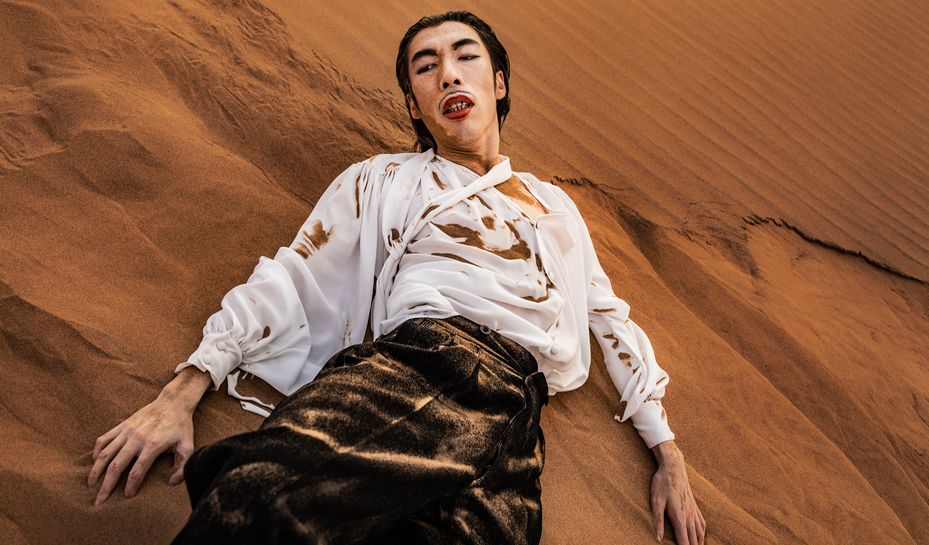
I believe it’s already premiering in Locarno at the moment. We have done all of the scenes on the dunes in a desert. This was a much bigger challenge than the previous W. I’ve gotta portray 2 roles at once, but that’s actually one single role. That’s over your head at this point, I know it, haha. I mean, I gotta portray the role himself as well as his doppelgänger. I was so hostile towards myself, blaming myself, and so I kill myself. There’s a telephone booth on a dune but it always sank into the sand, so every time we gotta guess where the heck is our booth again and again. I was born in a very hilly place so hiking definitely isn’t a problem to me. However, walking up a hill on a sandy dune is 10 times harder than going up a real hill, even though the dune is less steep than a hill. Meanwhile I also gotta walk on my last legs, breathe my last breath on the phone, and be dragged away by Johannes. The efforts we made were greater than ever.
The Dunes of Void was originally written for Anna’s film E, though it ultimately became a standalone release. How did the idea for the track take shape in the context of your conversations with her?
I had already promised her the soundtrack in our shooting days. Normally I should have done it months after the shooting days, but there were still so many other things to deal with; so my working system only got ready recently, and the track can also be done at the same time. That’s too late for her to directly fit into the film. To be honest, I got more inspiration for this track from Johannes’ home than the dunes we actually filmed on, though the scenes were still giving me that spatial vibe and air. Even if we ended up filming in somewhere like Australia instead, I’ll still likely feel the same.
Even though it didn’t make it into the final cut, the piece still feels deeply connected to E. Was it written for a particular moment in the film, or more as an abstract response to the themes and atmosphere?
Hmm… some of both, perhaps. I’ve actually forgotten quite a lot of details in most scenes while making that soundtrack. I proposed to make 2 to 3 sections of soundtrack for a few different scenes, from slow to rapid paces, from the energy of void and emptiness to that tension of rushing. I tried to recall every different segment and fragment of every scene, the actual filming ambiance, and the overall vibe of the film. I guess, with a bit of impressionism in my mind, like how the music in Silhouette was written. I used to be ready to write even more different variations in case she uses it and asks for it.
In this track, you’re credited with every stage of the process—composition, performance, editing, mixing, mastering. Is that solitary, hands-on approach typical of your way of working?
Sometimes I do so, but not always. You may say I kinda know how to do every stage and position in musical production. In fact, I rarely ever worked on each of them individually for others. Sometimes I’ll do most or all of them myself if it’s necessary or it’s on demand, but usually I still would like to ask or let others share my different stages of work. I appreciate different styles, manners, ears and points of view from others, it helps to enrich the colours of my music. Furthermore, I don’t think I always have that much time and energy to do everything myself, so I may only do 1 or 2 things and leave the rest to others. I’m looking forward to any possible ways of collaboration.
You’ve mentioned that your music system only became fully operational recently, which delayed completion of the piece. Did that downtime influence how the track evolved?
That hasn’t changed most of my original ideas really much, but indeed it has delayed all of my plans and works a lot. Meanwhile I got some extra life experiences during this period that gave me more ideas for extra musical plans adding to my existing ones.
Has your work as an actor changed how you experience time, rhythm, or narrative in your music?
I don’t think it changes these 3 elements in my existing music, but my work in film gave me new ideas and inspiration that I would like to try in some new types of music like Broadway music, theatre jazz, and story driven types, in addition to my existing genres. Drama and music actually aren’t that different from each other anyway. There’s a type of drama made especially for music – music video. I can still recall some music videos I watched as a child, such as the scenes on a bridge in a Californian city or Brooklyn Bridge, or sitting in a house with the sunset shining through a blind.
What influences—musical or otherwise—do you feel reverberate through The Dunes of Void?
That first basic music type I learnt in my early musical lessons. I rarely think about it myself in fact. But, as I looked about in the dunes, listening to the wind on the dunes and people living there like Johannes, the first thing come to my mind was the American West, with all that proto delta blues music in the desert. That was a call of intuition that made me believe I could make it right away. I also recalled a scene in Minions that proved my line of thought. That scene was them asking for a lift on a highway.
Would you be open to scoring an entire film in the future, or do you prefer to work independently of visual media?
I feel like I’ll less likely score all of the music in an entire film. Film scoring isn’t what I learnt specifically. In case once I really gotta do it, I can only score some of them in the film rather than all of them, or I gotta score the film with others. That also depends on what film and what music they ask for. I’ll likely score more songs than music, that’s rather what I’m good at.
Are there particular stories, visual artists, or filmmakers outside of Anna Eriksson who inspire your music?
Hard to tell. This question stumps me, wow! No real particular one or few of them I focus on. My taste for music is too widespread and “greedy”. The music I listen to and inspire me could be from the end of the 19th century to the music just released this year. No lie, I got lots of 1920’s, 1940’s, 1950’s, 1970’s, 80’s ~ 2010’s music in my playlist, from Nat King Cole to Frank Sinatra, Ella Fitzgerald, Bee Gees, Earth Wind & Fire, George Michael, New Edition, MJ, Boyz II Men, NKOTB, Backstreet Boys to even Silk Sonic. I also incorporate European music like ABBA, Lisa Stansfield and Jamiroquai and Japanese music like Misia and Toshinobu Kubota, and many more. All of the above are still only a tiny “nano-tip” of the iceberg, and I haven’t yet mentioned some others I also would like to listen to like Latin music and classical music. Yes, sometimes I listen to classical music like Pyotr Tchaikovsky and Richard Strauss, though my mom is actually more into classical music than I am. I listen to other film scores too, the scores from John Williams are essential. As for working on my vocals, my voice teacher used to recommend me listening to Boyz II Men, but now I’m more into Peabo Bryson’s voice, alongside the classical lyrical voices like Luciano Pavarotti and Andrea Bocelli… Oh well, guess I gotta stop this topic here as that’s gonna be longer than all of the Harry Potter movies in order to complete it.
Finally, what can listeners expect from you next? Is The Dunes of Void a self-contained release, or part of a larger cycle you’re currently exploring?
I don’t limit my target audience. I’ll try to write things for as many types of people as I can, as long as they’re all the genres and styles I can handle. The Dunes of Void isn’t gonna be the first priority I’ll consider to put into any my EPs, albums or collections, but it’s still possible. Now some known plans in my mind are some genres like funk, boardway disco, fast and slow R&B, and soul. In particular, I’m considering mixing orchestral sounds with synthesizers. Also, some slower ballad tracks are on my task list, and I prefer more electric pianos for these. The electric piano is one of my favourite instruments, particularly Rhodes, like Mark I, Mark II, V, VII and Dyno. I also like some electric piano sounds from synthesizers like Roland, Hammond organs, and saxophones too.
Listen to The Dunes of Void now on all platforms.
About the Author