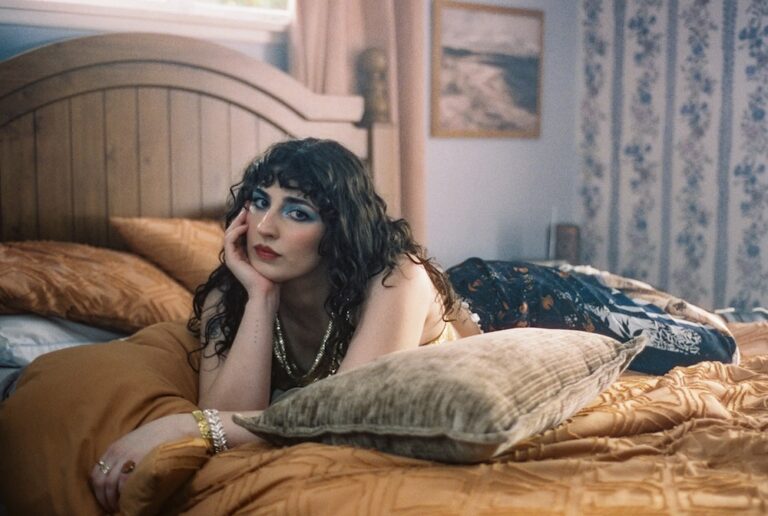
Rachel Bochner
The Brooklyn-based indie-pop artist opens up about I Guess A Sure Thing Couldn’t Go Down Gently, exploring emotional upheaval and self-acceptance
With her sharp, emotionally charged songwriting and an unflinching approach to deeply personal subjects, Brooklyn-based indie-pop artist Rachel Bochner has carved out a distinctive space in contemporary indie-pop. Her new album, I Guess A Sure Thing Couldn’t Go Down Gently, explores the complicated intersection of love, loss, identity and self-discovery, turning the end of a long-term relationship into an intimate examination of grief, guilt and the process of coming to terms with her queer identity. Written in the aftermath of her relationship with a man, the record captures a period of profound emotional upheaval, when the pain of losing a life she had built coexisted with the exhilaration of discovering a more authentic sense of self. Across its songs, Bochner confronts the contradictions of that experience, questioning the narratives we construct around personal responsibility, the ways guilt can distort our understanding of ourselves, and the difficult journey toward acceptance. Album highlight “Fault Line” brings these themes into particularly sharp focus, pairing an infectious pop sensibility with an exploration of self-blame and the temptation to see oneself as inherently destructive rather than acknowledge the complexities of human relationships.
In our interview, Bochner discusses the personal experiences behind the album, the complicated coexistence of grief and joy, and how songwriting became a way to confront emotions she might otherwise have struggled to articulate. She also reflects on the challenges of writing about accountability, the creative decisions behind the record, and what happens when deeply personal songs take on new meanings through the people who listen to them.
I Guess A Sure Thing Couldn’t Go Down Gently is described as a breakup album, but it seems to be about much more than the end of a relationship. What did you discover about yourself while writing it? How did your queer identity change the way you understood the relationship, both while you were in it and after it ended?
The album is about a breakup, but you’re right, it is also very much about the complicated relationship with grief, shame, and identity that informed both the breakdown of the relationship and the aftermath. Coming to terms with my queer identity recontextualized not only that relationship, but all of the life I’d lived leading up to that point too. There was an immense amount of guilt attached to realizing something about myself that, in hindsight, seemed so obvious. I spent a lot of time questioning how I hadn’t recognized it sooner and feeling solely responsible for the pain that came with that realization. Writing the album and sitting with everything that happened helped me understand that I can take accountability for the ways I hurt someone without dismissing my own experience. I did the best I could with the information and understanding I had at that moment in time. I am not inherently evil for not being able to avoid hurting people while navigating this very complicated situation, I am just human.
You’ve spoken about experiencing immense grief and immense joy at the same time. How did you make sense of those seemingly contradictory emotions?
For a long time, I really struggled with the idea that I was allowed to experience joy when so much pain existed alongside it. There was this incredible sense of freedom and excitement that came with understanding myself more fully, but it was accompanied by the realization that getting to that place meant dismantling a life I had spent years building. I tried to compartmentalize those feelings by really leaning into the visual world and rollout of Lovergirl. It was the perfect distraction to help me avoid looking all that grief directly in the face, which obviously wasn’t a particularly sustainable solution. Writing this album forced me to acknowledge that both experiences not only deserved but demanded space.
How did your journey as an artist begin, and when did you first realize that music was something you wanted to pursue seriously?
I’ve loved music and performing for as long as I can remember. Growing up, I always loved being on a stage and regularly forced my parents to watch me put on elaborate shows with my sisters. Somehow, though, it took me a little longer to realize that being an artist was something I could actually pursue. I interned at Republic Records in the summer of 2018 doing A&R, which was honestly a catalyst for me beginning to take my songwriting seriously. I started releasing music around the beginning of COVID, which meant a lot of DIY visuals, a ton of social media networking, demos recorded in my closet, and Zoom sessions. When the world opened back up, I moved into the city, quit my full-time day job, and started playing live shows… I’ve been all in ever since.
On “Fault Line,” you explore the idea of convincing yourself that you are inherently destructive because that explanation can feel easier than confronting a more complicated reality. Why was that something you needed to put into a song?
I think it’s a really common human impulse to want a definitive explanation for why something went wrong. In my case, I was so consumed by guilt that I started convincing myself I was just fundamentally destructive. If I was the problem, then at least there was a clear explanation for everything that had happened. But that kind of thinking is also a way of avoiding the beautiful and terrible nuance of a situation. It’s much easier to decide you’re a bad person than to acknowledge that you made mistakes, that other circumstances were at play, and that sometimes people change in ways that make previously established relationships impossible to sustain. “Fault Line” is me exploring that mindset and the absurdity of turning yourself into some inevitable force of destruction in a slightly tongue in cheek way. It’s an unhealthy manifestation of guilt, sure, but it’s also a banger, IMO.
What initially drew you to songwriting as a form of self-expression?
I am a naturally avoidant person, but I found that writing felt like a safe way for me to unpack my thoughts, get hard things off my chest, and be vulnerable without wanting to shy away from it. I love the idea of taking an experience or emotion that feels really specific to me and finding language and imagery and production that allow someone else to connect with it really deeply. Sometimes I write something because I need to understand it myself, and other times I write something because I think there’s a feeling or experience that deserves to be explored. Either way, there’s something really fulfilling about turning an otherwise intangible emotion into something that takes up space.
Was there a particular song on the album that was especially difficult to write?
I mean, most of them. “Devil” and “By Omission” definitely required me to sit with some pretty uncomfortable feelings. A lot of the album explores guilt and accountability and complex acceptance, but those songs particularly forced me to examine the ways I had contributed to the circumstances surrounding the breakup and how I chose to cope with it. It’s one thing to write about being hurt. It’s another to write about the ways you’ve hurt someone else and the shame that comes with recognizing that. I wanted to be honest about the experience, which meant being very vulnerable about a lot of things that felt particularly ugly.
The album’s title is unusually long and almost sounds like a sentence someone might say after a painful realization. When did you know that was the title?
The title comes from a lyric in “Furniture.” I went back and forth on the album title for a while because this is my first full length record! It felt like such a significant project to put into the world. I wanted to hear a potential title for the album and immediately know that it couldn’t be anything else. When I revisited that lyric, it just clicked. The idea that something you once considered a sure thing can still come undone (and come crashing when it does) – it really encapsulated all of the feelings in the record well. It’s a wordy record… it was only fitting that the title is a mouthful too. Something concise and tidy would have felt dishonest!
Your lyrics are very candid, but the music still has a strong sense of pop immediacy. How do you balance emotional vulnerability with the desire to make something people simply want to listen to again and again?
That’s one of my favorite things about making music. I love the contrast of writing something really devastating and then putting it to a melody that gets stuck in your head for the next 48 hours. Emotions are never one dimensional – why should the songs I write about them be any less nuanced?! I love pop music, I love a good hook, and I want people to enjoy listening to the songs even if they’re not necessarily dissecting every lyric. And then, I want their jaws to drop when they do listen closely to what I’m saying.
Were there any songs that changed dramatically during the recording process compared with how you originally imagined them?
“Devil” took a while to crack. Tiger and I went back and forth on a handful of versions until we landed on the final one. Maybe it was the emotional weight that track carried that made us both be so precious about the production. We just knew something wasn’t right until we changed everything, changed it back, changed it again, and then finally found that one element that was throwing off the rest of the song. I’m so grateful to work with people who care as deeply about the art we’re making as I do. I wouldn’t change anything about the final song or the journey we took to get there.
Now that the album is finished and belongs partly to the listeners who connect with it, do you feel differently about the experiences that inspired it?
Once I put a song out into the world, the meaning begins to shapeshift. There will always be the experiences that inspired me to write the song in the first place, but that honestly becomes obsolete depending on who is listening to the song. Most people aren’t listening to these songs with all of the context about who I am and what inspired the album, and that’s completely fine. Maybe they stumble upon “Furniture” on a random playlist and it reminds them of the devastating friendship break up they had with a college roommate that resulted in someone dramatically moving out. Suddenly, that is exactly what the song is about! We take what we need from the art we consume, so I always encourage and celebrate whatever interpretation a listener has for my songs. It’s so magical for something to begin as such a personal and isolating experience and then become a shared point of connection.
Official website of Rachel Bochner
About the Author