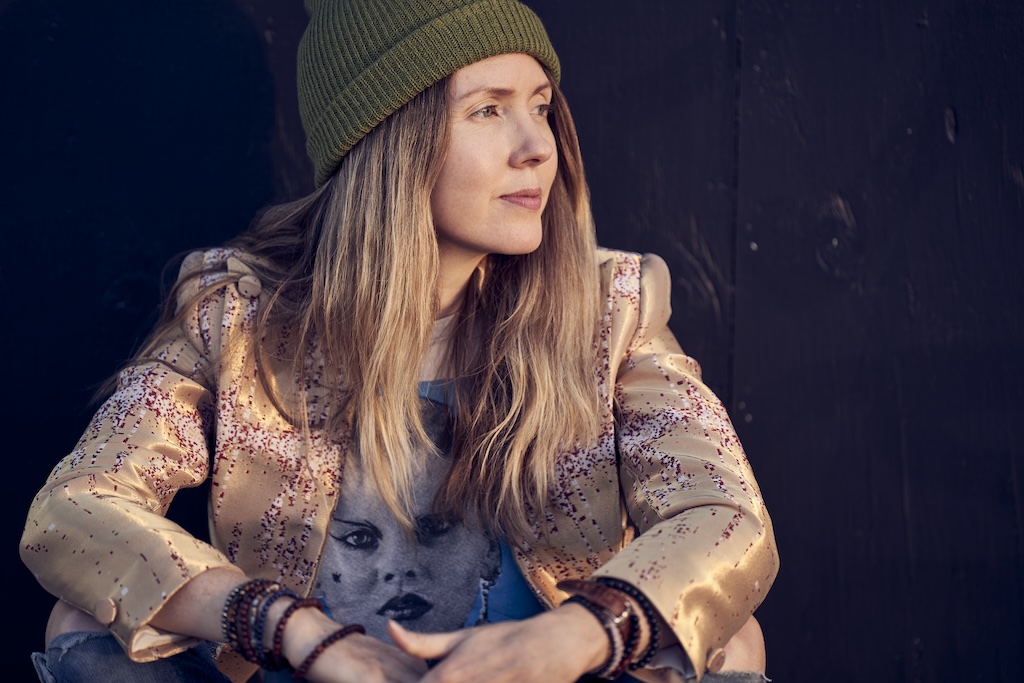
Beatie Wolfe photographed by Mario De Lopez
In our exclusive interview with Beatie Wolfe, the artist who has long defied convention by weaving together music, art, science, and technology into a body of work as pioneering as it is poetic, we explore the next chapter of her boundary-pushing collaborations with Brian Eno. A true shape-shifter who has pressed records on bioplastic, beamed an album into space, and staged her own V&A exhibition, Wolfe treats music not as a format but as a living organism. Together with Eno, she has been building a trilogy of albums that map new musical planes: Luminal (dream music), Lateral (space music), and now Liminal (Dark Matter music), out October 10 on Verve Records. Announced alongside the release of the double single — the vocal track “The Last to Know” and instrumental “Ringing Ocean” — Liminal unites the previous albums’ worlds in a “strange new land,” flickering between song and non-song, reality and hallucination — the kind of work that transports you to a place which has never existed, but should have. The album will be released digitally, as well as on eco-friendly CD, black biovinyl, and a translucent rose biovinyl webstore exclusive. And while Liminal closes out the trilogy, Wolfe hints that it won’t be the last chapter in their collaboration.
Can you describe your process for collaborating with a second composer and how it differs from your usual approach? Is it easier or more difficult, what aspects have taken you by surprise?
When I write alone, a lot of the music comes very easily, seemingly out of nowhere, it’s a very intuitive process and it’s always been like that. It feels like magic. With Brian, it’s almost exactly the same, like we’re both tuned into something and it’s revealing itself through us following it. That is pretty amazing, having that experience with someone else, as you’re both able to expand that world in different though entirely integrated ways. I’ve never had that working with another person. That’s why when Henry Rollins said “It’s as if two people found themselves in the same dream…” he summed it up perfectly.
How has your approach to creating music evolved since your first project together, Lateral? What’s different about this album?
There hasn’t been a linear time progression with these albums, they’ve really been forming concurrently and it just so happened that Luminal and Lateral felt like the first pair that went together with Liminal existing somewhere in between or beyond. But really we’re working on so much music across the spectrum, and simultaneously, that it’s all happened back-to-front in many ways e.g. making the music and then figuring out what world it belongs to.
You describe Liminal as “Dark Matter music.” What themes do you feel encapsulate this “strange new land” in the album?
Well neither of us really think like that though it’s a very natural question to ask. To us Liminal feels like a kind of brave new world, not really in the Huxley sense but still something quite impossible to imagine… a land between lands, with new senses, textures, planes/plains…. As far out as it is far in.
Can you walk us through how you and Brian Eno define the feeling space of Liminal in contrast to Luminal and Lateral? How did those differences manifest in the music?
Well I guess it goes back to those first descriptors. If Luminal is dream music, dwelling in the world of feelings, new feelings, and Lateral is space music, exploring / expanding the planes of time, then Liminal is perhaps the undiscovered.
When did you first realize that music was your true passion, and what was the first instrument you learned to play?
I remember hearing “I Can See Clearly Now” (the Jimmy Cliff version) when I was about 5 and it felt so incredibly moving and alive to me, it really spoke to me, and I remember thinking ‘that’s the song I want to be played at my funeral’ which is a pretty curious thought to have at that age. The first instrument I learnt to play was the keyboard when I was age 6/7, but I always saw it as a tool to compose on, that’s what interested me. Then I picked up the guitar when I was about 13 or 14 and that felt much more like my instrument.
Your work spans across music, design, and technology — you’ve even held a solo exhibition at the Victoria & Albert Museum. How do these different creative practices influence your musicianship?
I couldn’t tell you. I just know that for me it never made sense to confine creativity to one space, one medium, one lane… I felt as if those different practices all enriched one another enormously. It’s the same reason I get a huge amount of passion from bringing science and art and other fields together, because there is so much to be gained from that dialogue.
The fusion of digital and physical is a common thread in your work, can you tell us about any new innovations you’ve explored in Liminal that combine both these worlds?
Those are coming.
You’ve been at the forefront of pioneering new music formats, such as the bioplastic record. How do you see the role of physical objects evolving in an increasingly digital music landscape?
I think they will continue to become more precious and valued. Tangibility is such an important component for music, art and well, Life… Tangibility grounds us in the here and now, while also tapping into much greater timelines (think of how it feels to discover a fossil or hold a book like Origin of the Species), it becomes a portal in that sense. Tangibility helps to instill presence and ceremony. So tangible art forms, made well, will always win out over anything digital in my opinion as they connect us with expanded time and space.
Can you tell us about the design of the album trilogy’s cover art? How did you choose it, and what does it symbolize?
We were trying various ideas, Brian wanted to have photos of us, but the look and feel kept ending up quite dark and heavy overall. Brian had shown me some of his light painting etchings, separately, and they had stayed in my mind. When I thought about the music it felt so alive, so luminous and warm and that’s exactly how those star etchings felt. They vibrated. So I suggested we go with those instead.
What musicians inspire you, and what art, films, or literature are currently meaningful to you?
I am inspired by so much. Nature. Life in the full spectrum. To me, Life is the greatest creative work of all. In terms of art, films, literature, I find myself often returning to a few that continually give me so much… Odilon Redon, Matisse (especially his cut outs), David Hockney, Arpita Singh, Hilma AF Klint, Harold and Maude (and many Hal Ashby films), Monty Python, The Enigma of Kasper Hauser, Navajo art and stories (a lot of Native American art), Tu Fu, William Blake, Oliver Sacks and Musicophilia (a book that changed my life), and too much music to list. And all those people who want to leave this planet a little better than when they arrived.
The album features a track called “Before Life.” Can you share any insight into the existential reflections that inspired this piece? Are you a spiritual person?
I am. I believe most people are but in very different ways and it is those differences that we should embrace. The problem with religion is in its mutual exclusivity. And the problem with a lot of spirituality is its similar need to appoint a guru, a single “way”. I always think of William Blake’s line (on religion) “Thus men forgot that All deities reside in the human breast.”
You’ve worked on some pretty impressive and avant-garde projects—what’s something unexpected about you, maybe something your fans might be surprised to learn about your creative process or personal interests?
I used to be a ninja.
With Liminal releasing on October 10, what do you hope listeners take away from the album?
New worlds, new feelings, new ways of being.
You and Brian Eno have already released two collaborative projects this year, are you planning on continuing your collaboration after this trilogy?
Yes.
What’s next for you after Liminal? Any new projects in the works that you’re particularly excited about?
Always.
Check out the official website of Beatie Wolfe.
About the Author