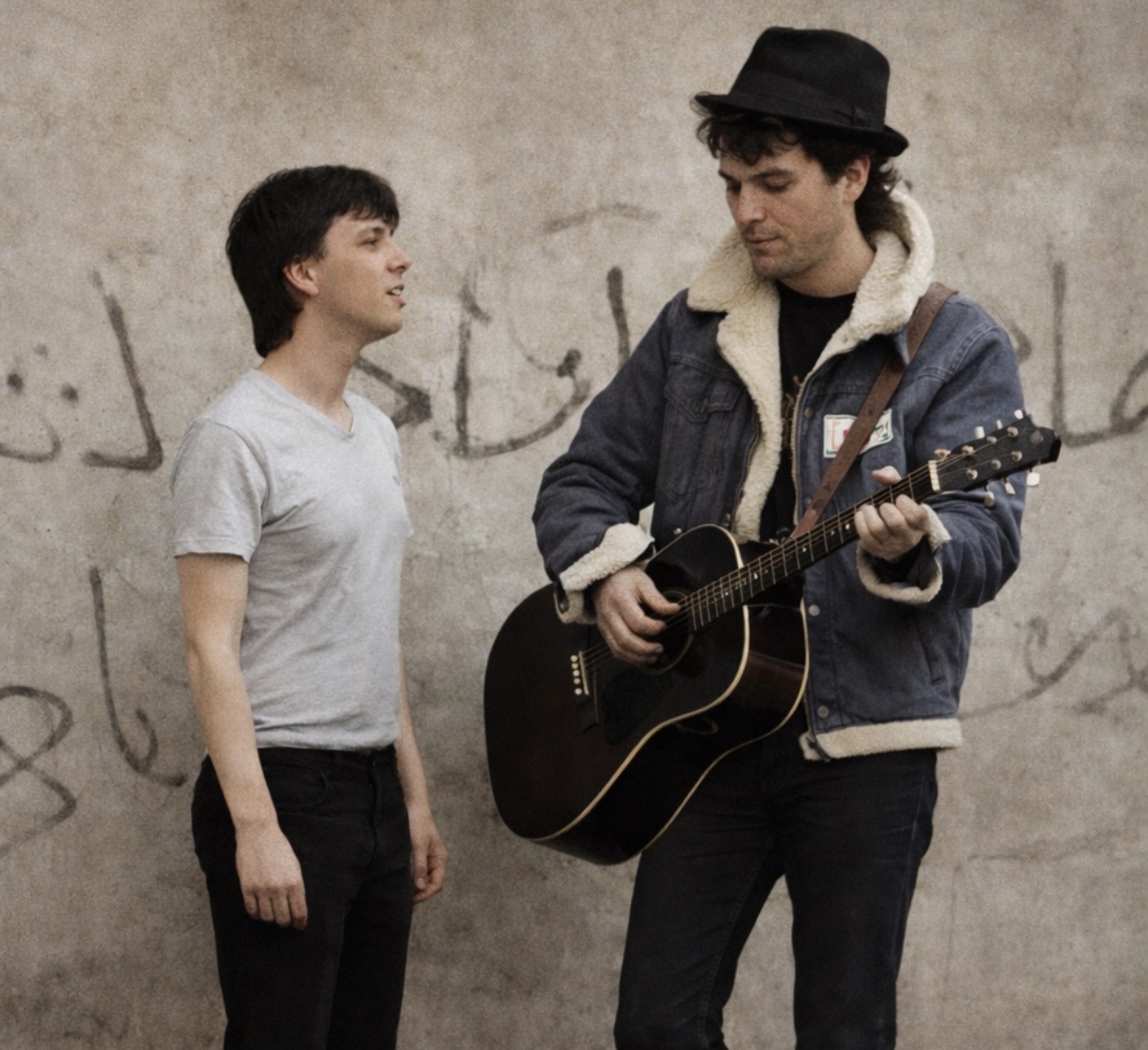
Cassius Wolf & Das Abs
After nearly five decades, the Liverpool duo resurrect long-lost cassette recordings, revisiting the spirit of Eric’s while proving that creativity has no expiration date.
Few bands can claim to have stood at the centre of Liverpool’s original post-punk explosion while quietly keeping their own story hidden for nearly five decades. Cassius Wolf & Das Abs formed in 1978 after lifelong friends Cassius Wolf and Don Watson met at school aged just 11 and later found themselves working at the legendary Eric’s club alongside the emergence of Echo & the Bunnymen, OMD, The Teardrop Explodes, and countless other defining acts of the era. While many of their contemporaries went on to international recognition, the duo chose a different path, preserving complete creative independence as their songs remained unheard outside a small circle, captured only on home-recorded cassette tapes.
Now those long-lost recordings have been meticulously restored and transformed into An Afternoon in Bedlam, an album that feels remarkably contemporary despite its origins in the early 1980s. Inspired by the history of Bethlem Royal Hospital and its disturbing legacy of public spectacle, the record explores communication breakdown, conflict, alienation, and the enduring cycles of human behaviour through a distinctive blend of post-punk, reggae, dub, and melodic alternative rock. More than a rediscovered archive, the album represents the band’s belief that creativity has no expiry date—a philosophy they call “PCore”—proving that artistic ambition can remain as urgent, uncompromising, and relevant decades after it first began. In conversation with Indie Sound, Cassius Wolf and Don Watson reflect on Liverpool’s legendary music scene, revisiting their younger selves, and why some ideas only find their moment when the world finally catches up.
Cassius and Don, you’ve known each other since you were 11 years old. What first connected you as friends and future collaborators?
C: Don’s older brother Keith was a DJ and he had a big record collection. Don was into obscure 60’s psychedelic bands and we always connected through music.
D: We always kept our ears open for new music and obviously when punk happened it was like a breath of fresh air.
You both worked at Eric’s during one of Liverpool’s most influential musical eras. What are your strongest memories of that time?
C: There are so many. It was a creative period that we never thought would grow to become so influential. For me, the strongest memories are repairing the ladies’ toilets, which had blocked and flooded the venue during a gig.
D: When you think of the bands that we saw, it’s mind-blowing really. Joy Division, The Clash, Gang of Four. The list goes on and on. It wasn’t just the bands either. The records played by the DJs were a mix of the new and obscure old stuff we’d never heard before.
How did being surrounded by bands like Echo & the Bunnymen, OMD, and The Teardrop Explodes shape your own musical identity?
C: I think the range of music that was played—from The Clash to avant-garde bands like Pere Ubu, The Residents, Captain Beefheart, mixed with dub reggae—influenced all the musicians in that scene.
When you listen back to your earliest recordings, what do you hear in those younger versions of yourselves?
C: Mainly the topics that were relevant at the time: teenage angst, political activism, the poetry of Rimbaud, and watching Joy Division and The Fall.
D: The willingness to have a go. To mess around and see what transpired onto the cassettes.
What inspired you to revisit and restore material from your original cassette archives after all these years?
C: A lot of people had been asking why we had never released music to the public before, and it was mainly a combination of cost and not wanting to work within the framework of a traditional record company. We always wanted control of what we released, and now that is possible.
The album’s title draws on Bethlem Royal Hospital and the idea of “Bedlam,” while also reflecting on society’s fascination with spectacle and division. What drew you to that historical reference, and how do you see its themes connecting to the modern world?
C: An Afternoon In Bedlam represents the darker side of the human psyche. It manifests in Jungian archetypes, and there was a strong Jungian influence on the late seventies Liverpool music scene.
It’s clearly apparent in the obsession with social media and online culture in general. The internet itself could be viewed as a modern-day Bedlam.
Was there a particular event or moment that sparked the album’s broader themes of unrest, conflict, and alienation?
C: Not really. It reflects our worldview from a particular moment in time around 1981. We think the topics are still relevant and the album has a timeless quality that takes it away from the purely nostalgic.
The album explores both personal and societal instability. How do those two forms of chaos intersect throughout the record?
C: That’s a good question. I’d like to think that the songs have sufficient depth to make the listener think about broader subjects and inspire some self-reflection.
Do you see An Afternoon in Bedlam as a social commentary, a personal reflection, or a combination of both?
C: There’s a bit of everything. Hopefully people can relate on a personal level or from a broader perspective if that’s where it takes them.
“I Can’t Reply” focuses on communication breakdown. Why do you think genuine communication feels increasingly difficult in modern life?
C: It’s a lot harder to become self-aware and express genuine emotions these days. Communication has become more difficult in an age where emojis and text messages form the basis of interaction.
“Losing Sleep” has a more melodic and uplifting musical energy despite its subject matter. Do you enjoy playing with that contrast?
C: Yes, that is a recurring theme in the music. People find “Lovers Cancer” the most difficult to listen to because the title and subject matter is so jarring, yet the music is perhaps the most catchy and upbeat in sharp contrast.
“The Sound of the Guns” delivers an anti-war message. What inspired the song, and why does that theme remain relevant today?
C: I wrote the song specifically about the civilian suffering in the CIA-backed war in Nicaragua in 1981. Sadly, the lyrics could pertain to any of the conflicts we see in the world today.
D: Nothing changes really. Those in power still want to cause harm to others for their own ends!
Reggae influences appear throughout the album, particularly on “Controls To Extremes.” What role did reggae culture play in shaping your musical outlook?
C: I grew up in South Toxteth, which is a multicultural part of Liverpool. Caribbean music and The Beatles were part of the musical DNA.
D: I always thought that the wild experimentation by the likes of Lee “Scratch” Perry and Dr. Alimantado fitted into our general musical tastes.
“Tell Me” explores emotional uncertainty and distance. Do you think ambiguity is an important part of songwriting?
C: Yes, that’s a good point. Uncertainty is something we all face, especially when navigating the emotional tension in a relationship. If people can relate to that in music, then hopefully they can understand each other better.
Were there any songs on the album that took on new meanings when revisited decades later?
C: Yes, I think “Believe Me” has taken on a more general meaning about honesty and openness in a relationship, when it was actually written as a tribute to Ian Curtis, who I’d gotten to know at Eric’s.
What was the process of restoring and reworking the original analogue recordings?
C: The whole album was done in Don’s garage, where he has a small studio. I compare it to restoring old photos. You can use plugins to remove all the hiss and noise. We then ran all the stems through a process that quantised, applied EQ, and generally tightened up the tracks. We replaced all the drum parts and made the vocals sound much more robust than the originals. Finally, all the mixing and mastering was done using online tools. It’s amazing how much the recording process has improved and is now accessible in a DIY setting.
D: We couldn’t have done this 10 years ago, and I see this process as quite punk rock. Pretty much anybody with a bit of imagination can do something similar. You don’t need to be a computer graduate to use these tools, and it’s open for anyone to have a go.
How did you decide what to preserve from the original recordings and what to update using modern technology?
C: We’ve always used drum machines or software in the past. I’m quite comfortable programming drum loops from scratch, but these recordings needed to have a human feel to the rhythm, and I think we’ve achieved that.
Did revisiting these songs ever feel like having a conversation with your younger selves?
C: Yes, very much, although the process was like creating how we would have wanted the songs to sound had we worked with a producer and a 24-track analogue studio back then.
Were there moments where you were surprised by how relevant some of the older material still felt?
C: Yes, the songs resonated with today. I don’t think we’d have released anything that didn’t have a contemporary feel.
How do you balance nostalgia with the desire to create something that feels contemporary?
C: The songs were all written around 1981, so they represent a specific snapshot of that time, which will appeal to some people in a nostalgic sense. That’s a good thing, but I’d like to think that young musicians will be able to relate to it equally without needing the historical background.
D: Nostalgia’s OK for a holiday, but I wouldn’t want to live there. 🤣
The album draws inspiration from artists ranging from The Cure and Depeche Mode to The Clash and Steel Pulse. How did those influences come together naturally within your sound?
C: That’s the easiest way of categorising the sounds to explain the time reference. I think the influences are broader, and overall the album is quite unique.
Post-punk has experienced a significant resurgence in recent years. Why do you think younger audiences continue to connect with the genre?
C: It was the first genre that encouraged self-awareness and self-expression as a core value. People can relate to the personal and emotional elements in post-punk.
D: Well, you don’t need to have been to music school to play punk rock. The genre allows you to tap into your own imagination. In fact, if you have limited musical training, you have to work harder for the end results, which are often totally unpredictable. Far more fun than following chord charts!
What aspects of the original post-punk ethos do you think remain important today?
C: Fairness, integrity, honesty, empathy, and open-minded people.
D: …and tolerance of difference!!
The album moves between post-punk, reggae, dub, and pop influences. Do you consciously think about genre when writing, or do the songs lead the way?
C: The songs themselves have a way of striking their own identity. We don’t write in any particular genre, and there are so many more songs from later times that are completely different.
You’ve maintained control over songwriting, production, and visual presentation. How important is that independence to the project?
C: We always valued artists that worked alone or with like-minded collaborators. The ethos of anarchist bands like Crass in the seventies was very inspiring. We think the DIY aspect is very important, and now the technology has caught up.
How has modern recording technology changed the way you create compared to the late 1970s and early 1980s?
C: The process and the ethos of recording are exactly the same, only now the final output is much more sophisticated.
What are the advantages of working from a home studio environment?
C: Mainly financial. To have recorded An Afternoon In Bedlam in 1981 would have cost in excess of £50,000. It has been completed and released at a fraction of that. Also, there is no pressure or time constraints that we would have faced in the past.
D: …and it’s not far to walk to work!
Has the DIY spirit of punk remained central to your approach over the years?
C: Yes, the punk attitude is important. We have always believed that creative self-expression is central to happiness, so we support anyone who has that passion.
You’ve spoken about “PCore” as a movement celebrating creativity later in life. How would you define that philosophy?
C: PCore refers to that punk attitude that we spoke about. That “three chords, go form a band” mandate that formed the original punk movement, as opposed to any particular sound or genre. It has jokingly been called “Pension Core” because a lot of creators have now reached pension age, and the audience demographic for music has become older too.
D: Interestingly, when I go to see live bands nowadays, the bands are all in their mid-twenties and younger, but the audiences are our age. We don’t see that many new old bands unless they’re playing 60-year-old Stones riffs in the local pub! But just because you’re over a certain age doesn’t mean you can’t have new ideas influenced by the new music being created by the newer kids on the block.
Why do you think society often associates artistic innovation with youth?
C: I believe it has a lot to do with the erroneous belief that people reach their creative peak in their twenties. Art in general has been produced across generations for millennia, so it’s no surprise that music should be the same. I think the invention of the teenager and the associated rebellion of youth in the fifties and sixties set those ideas into mainstream thought, but there are many examples of people continuing to produce quality work into old age.
D: We probably had that same attitude when we were younger. Don’t want to listen to Grandad music. 🤣🤣 However, nowadays kids listen to, and are very influenced by, music made 50 or 60 years ago. Rock ‘n’ roll was fairly new when we were growing up.
What would you say to people who feel it’s too late to pursue a creative ambition?
C: I would say don’t wait. Now is the time to express whatever you want and don’t feel it’s ever too late. Don’t be defined by society’s expectations. If you are a rebellious 70-year-old, then good for you.
D: And creativity keeps you young. Writing a song is as good for you as an hour in the gym and following a macro diet!
Has your perspective on songwriting changed with age, or do the same creative instincts still drive you?
C: Personally, I’ve become less bothered with what other people think. I know that some people will like our stuff and most people won’t relate to it at all, and that’s fine. We’re not seeking validation, fame, or fortune. It’s part of our personal life journey, and it’s been a lot of fun. The response has been so much better than we expected.
D: It is fun. Personally, I’m a lot less self-conscious about what I’m creating and whether anybody else likes it.
What advantages does experience bring to the creative process?
C: You have a greater set of life experiences to call upon, and if you use this wisdom to your advantage, it can help enormously.
D: I’m not sure it’s advantageous—it’s different. Having little experience can also bring something unique to the creative process.
After bringing these archival songs back to life, has the experience inspired you to write entirely new material?
C: We have never stopped writing, so we have a lot of material to draw from. We are in discussions at the moment over which direction to take with the band, but there will definitely be a second album, which is likely to include a vinyl release. We’ll keep going as long as we’re having fun with it.
What do you hope listeners take away from An Afternoon in Bedlam beyond the music itself?
C: We’d like people to be inspired to follow our example and release their own music. It’s a new concept for bands to be releasing debut albums later in life, although in our case we feel that it’s just been delayed.
D: We want people to enjoy it and to feel inspired to do their own creative thing in whatever art form floats their boat.
Do you see this album as a revival of an unfinished chapter or the beginning of a new one?
C: The album is grounded in a particular time in our lives, so it has an identity that comes from that scene and genre. As individuals we have both moved on, so future releases have to reflect that, and hopefully people will join us on that journey. Putting together a live version will be an interesting prospect, but at the moment the cost is prohibitively expensive. It would be good though.
How do you feel the band’s story has changed between 1978 and today?
C: If you look at the career arcs of our friends like Echo & the Bunnymen, they have had artistic ups and downs but have kept going and are now given a great deal of respect for their achievements. If we can condense a 45-year musical journey into a couple of years and a few people enjoy our work, then that will be very satisfying.
If you could go back and play this album to your younger selves working at Eric’s, what do you think their reaction would be?
C: Wow, if I’d been given a copy of An Afternoon In Bedlam back then, it would have been straight round to the DJ box to get Norman Killon to play it in his set. 🙂 I’d love to have been able to play it to Roger Eagle, who was a mentor to so many of us.
What does creative longevity mean to you personally, and what keeps you inspired to continue making music today?
C: I’ve been making music all my life, and as long as it’s enjoyable, you don’t stop. I’ve never had to bother about self-promotion before, so it’s a new thing for me, but it’s been fun and great to meet new friends.
Thank you for these thoughtful and insightful questions. I’ve enjoyed answering them. It has been a pleasure talking with you.
About the Author