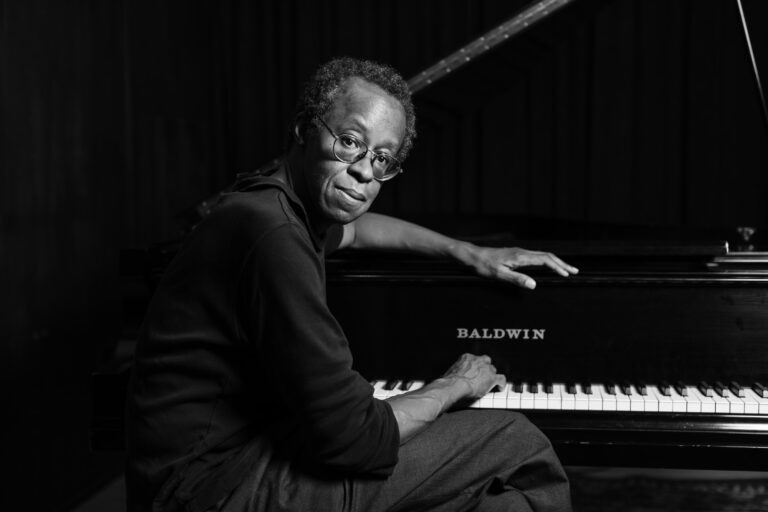
Matthew Shipp
The legendary pianist reflects on artistic identity, improvisation, the search for a personal language, and the enduring musical bond behind A Whole System Of.
For more than four decades, Matthew Shipp and William Parker have occupied a singular place within the world of contemporary improvised music — not only as two of its most distinctive individual voices, but as collaborators whose creative connection has developed into one of the most enduring and deeply explored musical partnerships of their generation. Emerging from the fertile New York creative music scene of the 1980s, both artists arrived with uncompromising artistic visions and a commitment to expanding the possibilities of jazz, composition, and spontaneous creation. Shipp’s unique piano language — shaped by classical music, bebop, post-bop, free jazz, and the innovations of artists such as Thelonious Monk, Cecil Taylor, Sun Ra, and John Coltrane — transformed those influences into a highly personal musical vocabulary defined by structure, abstraction, and emotional intensity. Parker’s equally distinctive approach to bass, rhythm, melody, and collective improvisation created a complementary force, allowing the two musicians to build a dialogue based on trust, intuition, and a shared pursuit of deeper musical possibilities. Their collaboration has produced countless recordings and performances across different configurations, but their duo work remains one of the clearest expressions of their connection. Their first duo recording, Zo (1994), captured the fearless energy of two artists discovering a shared language, and now, more than thirty years later, that conversation continues with A Whole System Of.
Set to be released on November 6, 2026, on TAO Forms, A Whole System Of arrives alongside the ESP-Disk’ reissue of their landmark first duo recording, Zo (1994), creating a conversation across more than thirty years of artistic evolution. The album captures Shipp and Parker’s rare ability to remain open-ended and unpredictable while drawing from a shared vocabulary built through decades of exploration. To mark the release, the duo will perform a rare concert at Roulette in Brooklyn on December 4. In this Indie Sound Magazine interview, Matthew Shipp reflects on his musical origins, the nature of improvisation, his lifelong search for expression, and the extraordinary creative bond that continues to define his work with William Parker.
You began playing piano at five years old, initially through classical music and the influence of a church organist. Looking back, what was it about the piano itself that captured your imagination so early?
It was more the majesty of the music. I grew up in an Episcopalian church and it was more the heavenly nature of the church music that drew me in first; more than the actual organ. The Episcopalian church is very similar to the Catholic church in some ways, and there were some themes that were like Gregorian chants that made me feel like I was seeing angels. Maybe I was seeing them.
Your early musical world in Wilmington, Delaware seems to have been incredibly fertile — from your parents’ record collection to local figures like Clifford Brown’s teacher Robert “Boysie” Lowery. How did that environment shape your sense of possibility as a young musician?
There is such a rich cultural history to Wilmington, and it being close to Philadelphia adds another layer — both in some ways sharing some aspects and also being so different despite being close. First of all, Coltrane had lived in Philadelphia, Sun Ra lived outside the city, so there is a regional vibe that extends to Wilmington in some ways. But Wilmington has its own distinct identity, and having been the hometown of Clifford Brown is center to that. There are a lot of great classical teachers in and around Wilmington. Plus, from a rock/blues standpoint, there is a beautiful tradition there also. There was so much to pick and choose from.
You have spoken about hearing Ahmad Jamal and Nina Simone on television as a turning point when you were around twelve years old. What was it about those artists that made you realize jazz was the language you wanted to explore?
There was a mystery to both of them — different mysteries — but mysteries to both of their artistic personalities. The thing about Jamal to a 12-year-old Matthew Shipp was the coolness he projected. It seemed so easy and just cool for him. To me, he embodied an archetype of a certain coolness that an older Black male figure could emit in the 1970s. With Nina — well, she scared me to death. It was powerful but jeez, she scared me. But I wanted to be scared more. I think I also related to the fact that there was a real blues essence to her, but completely side by side was her classical training, and they lived side by side in perfect symbiosis.
Before you developed your own unmistakable voice, you absorbed many different traditions — classical music, bebop, post-bop, free jazz, and beyond. Was there a moment when you felt, “I am no longer learning the language; I am beginning to speak my own”?
Yes, there was an exact eureka experience that happened to me the week before I started the year at New England Conservatory. I had arrived there and started playing with a sax player named Gary Joynes. During one of our sessions, all of this stuff started pouring out of me. I did not know what was happening. My style was born.
You have often described jazz as something closer to a language or code than an academic discipline. What does it mean to develop a personal musical language?
It means to follow the angels or the demons who speak to you without regard for the consequences. You do it because it is your vibration — because you must do it that way.
Many artists struggle with the weight of their influences. You have spoken about absorbing influences and transforming them into something personal. How do you recognize the difference between influence and imitation?
Well, the difference is in the way it sounds — but I guess the best answer is that it is all in the approach. You do not eat food to look like salad and steak. You digest it into your system to give you building blocks to build you. So you see me, not the salad and steak. Influences are food, and I want to see the artist, not Brussels sprouts.
Your influences range from Monk, Bud Powell, Duke Ellington, Bill Evans, McCoy Tyner, Cecil Taylor, Andrew Hill, Sun Ra, and John Coltrane. What qualities do you find yourself returning to in these artists again and again?
Grace — Beauty — elegance — originality — a cosmic quest — trying to do the impossible — sincerity — courage.
John Coltrane’s search for deeper musical and spiritual possibilities has been important to many artists. What does Coltrane’s legacy mean to you today?
To be honest, I am trying to get away — mainly because the way the Coltrane myth [and by myth all I mean is the projected image of him, which it seems to me to be based on reality] — but the myth of the big holy man. Coltrane on this mystical quest through sound played such a role in my upbringing and in the upbringing of so many jazz musicians that I feel it gets in the way at this point. Mysticism is actually dealing with what is and your vibration as the naked entity it is and actually in its pristine form without history. So obviously the whole Coltrane paradigm made a big impact on me, but I will not even listen to a Coltrane album at this point. There are other ways to approach the connection between mysticism and jazz than through the filter of Coltrane’s quest. And you will never see me in robes playing A Love Supreme.
When you began your career, what was the landscape like for a pianist and composer creating instrumental music outside of the mainstream? What challenges did you encounter while developing your own voice?
The challenges were more in getting a career than developing my voice. Short and simple, when I moved to NYC in the early 80s, no one that I know in the business was looking for a young Black kid who was playing in an idiom that was an extension of what Trane-Cecil-Ayler and Sun Ra were doing. No one that I know in the business was looking for a young Black kid who says, you know, I speak to angels and I play the piano in my own way. There seemed to be no need for someone like myself, and I get the sense other people thought it was unrealistic. To a lot of people it was alright for Sun Ra to say he was from outer space or for Cecil to be like he was because they had already won their battles to be in the history books, but how dare some young kid move to NY and not sound like them, to try to reinvent the thing, to be me and basically say, here I am. I have created my own language the way Monk and Cecil have and I talk to angels. When I moved here, the young lions were the talk and most new music people that got attention were white. A lot of people tried to make me out to be a rehash of the 60s, which is obviously bogus considering the content and originality of my approach. I had massive battles to fight and win and still do despite how much acclaim I have gotten.
You have described yourself as a modernist. After decades of creating music, what does “modern” mean to you now?
In the moment. I do not believe in linear time anyway.
Your music often feels simultaneously architectural and spontaneous. How do composition, intuition, and improvisation interact in your creative process?
I emit from the standpoint of a point creating a circle. In religious terms, you can call that point God. I’m not calling myself God — I am talking in a metaphor. So my music deals in subconscious forces that generate a space and time — so architecture is innate in following the genetic and spiritual impulse. It sounds coherent because I have discipline, which is a quality Sun Ra talks about a lot — the natural spontaneity along with the discipline. There is no dichotomy in my mind between improvisation and composition. Both [if there are different definitions to them] are disciplines. At the end of the day, I do what the angels tell me to do.
Do you think about the piano as an instrument with a history that you are extending, or do you approach it as a sound source with limitless possibilities?
Both at the same time — I try to be a virgin in regard to seeing the instrument emerge out of the Big Bang as a fresh vibration in creation, but at the same time I look at history as useful.
What role does silence play in your music?
Everything — the universe arises out of a matrix of silence — so silence is behind everything.
What is something about your music that you think listeners often misunderstand?
That it even exists. We come up with words to describe phenomena, but on some cosmic level there might be no difference between a musical composition and any other activity. Under the term music we put Coltrane — Karen Carpenter — John Cage — GG Allin — Kiss — Charlie Parker — Scott Joplin — Iannis Xenakis. So are these things connected? I don’t know. Maybe — maybe not.
What is something you believe now about music that you did not believe when you were younger?
When I was younger, I believed that great musicians operated within a moral code that was outstanding. When I was really young, I believed that great musicians were enlightened beings. Obviously, in a lot of cases that is not true.
When you arrived in New York in the mid-1980s, you entered a scene involving artists like William Parker, David S. Ware, and many others. What did that community teach you that could not have been learned anywhere else?
The actual code of the music that is passed down. That is nothing that can be taught in a school.
Do you think the New York environment of that era encouraged a different kind of artistic risk-taking than exists today?
Oh yes — the 80s was a volcano of life force and NYC was a vibrant hub of creativity. OMG, 80s NYC was alive with life. Risk-taking seemed to me to be the name of the day.
What role does community play in creating experimental music? Can radical individual expression exist without a creative ecosystem around it?
Wow — in one sense the Vision Festival scene is about community. But an iconoclast like David S. Ware did not want to be associated with any school. I guess both approaches can coexist. There is something to be said about community, and there is something to be said about isolation.
You have described William Parker as someone you specifically wanted to meet when you arrived in New York in 1984. What drew you to his music, and what did you recognize in each other when you first began playing together?
I saw William as a bridge between generations. He played with first-generation new music people like Cecil and Don Cherry — he played with people in his own generation like Daniel Carter and Roy Campbell, and he was open to a new generation like me and Rob Brown. He also embodied the old energies of the jazz avant-garde while being new and of the 80s. He is pure. We are brothers.
After more than four decades of collaboration across many different projects, what has allowed your musical relationship to remain so creatively alive?
I am possessed — pure and simple. Therefore, I would think I am very in touch with some deep aspects of the subconscious mind and maybe a pure channel.
William has a very distinctive approach to rhythm, space, melody, and collective improvisation. How has playing with him expanded or changed your own musical thinking?
It complements me — I do not think it changed me — but I have learned how to never be afraid of the vibrations that might come from Africa that are in the music. William is pure — I’m not saying the vibration he hits on is from Africa — it might be older than the planet itself — he has touched on some very deep things. A lot of people who are pure could be self-destructive because there is no place for purity on this planet and pure people a lot of times just cannot take this planet, but William is not self-destructive. Amazing.
In a long-running collaboration, how do you keep the music from becoming familiar or predictable?
I’m insane — so I am willing to go places and take chances a lot of people might not be. My insanity, along with my ability to be in the moment [for whatever reason I have that ability], allow me to remain fresh.
Do you feel that you and William have developed a shared vocabulary over the years — almost like two people speaking a language that others cannot quite hear?
When the genius they call God or first cause or the power that generated the universe — when that thing did what it did, I think it said to itself — William Parker and Matthew Shipp are an eternal team to create language together. Some things have no logical explanation.
After so many years of playing together, does the duo reveal more about the musicians you have become, or more about the musicians you were when you first connected?
Yes — after all these years, just the fact that the music renews itself on its own volition and uses us as channels is mind-blowing.
Your new album A Whole System Of is only the fourth duo recording in this particular Matthew Shipp–William Parker format. What made this moment feel like the right time for a new duo statement?
I know I always say this, but I believe I am bringing my recording career to an end. My first duo CD with William, Zo, really brought my name to people, so it feels like full circle. Also, none of us is getting younger. It just felt right.
The title A Whole System Of suggests something larger than individual pieces — perhaps a philosophy, an ecosystem, or an interconnected structure. What does that title mean to you?
Exactly what you said — it seems like you really understand where I am coming from.
Many of your album titles have a strong conceptual quality (The Multiplication Table, The Unidentifiable, The Conduct of Jazz, etc.). Do you usually begin an album with a philosophical idea or concept, or does the concept emerge after the music exists?
They come about together — philosophy is language — mysticism is language [to the extent that the mystical Christ is called The Word — Logos] — so I am involved with language trying to get away from itself to be pure being.
What was the emotional or philosophical center of this new recording? When you create an album, do you begin with a specific question, feeling, or concept, or does the meaning reveal itself through the process of playing and recording?
Love of playing with William Parker was the emotional center. And I loved the way you put that. The meaning reveals itself through playing and recording.
The cover artwork features a butterfly, an image often associated with transformation, evolution, and interconnected systems. Did the visual concept connect directly to the music, and do you think transformation is a central part of your creative process?
YES — YES — YES. YOU GOT IT.
The track titles on A Whole System Of — such as “Deeper Fields,” “Notions of Order,” “Momenta,” and “Wave Light non Form” — suggest ideas around perception, structure, and abstraction. Are these titles describing the music itself, or are they part of a larger conceptual framework?
My music cannot be described in words — I create it and I have no idea what it is. But the framework — yes, the framework that generates the music is what the titles are. I deal with grabbing form out of the formless — very Taoist of sorts.
When you enter the studio with William, how much of the music is discovered in the moment versus something already existing conceptually?
We just start playing — no talking about it or anything like that.
What do you hear differently in your duo relationship with William today compared with the early 1990s?
I’m not sure — we have lived so much life between then and now — I have problems remembering yesterday.
This album arrives alongside the reissue of Zo from 1994. Listening back almost thirty years later, what strikes you about that recording? Do you hear a direct line connecting Zo and A Whole System Of?
Yes, there is a direct line, but what strikes me about Zo is how brazen it was — I did not give a damn, this is what it is.
The duo will perform at Roulette in Brooklyn on December 4. After recording this music, does bringing it to the stage change the way you and William approach it?
Every time we play, we are in a different reality, which makes the vibration of the music different.
Does improvisation become freer or deeper when two musicians know each other for forty years?
There are different schools of thought with this. I can only state my preference, which is to develop trust and dialogue with like-minded people. That does not mean the dialogue falls into patterns.
If you could have a conversation with any composer or musician from the past, who would it be and what would you ask them?
Charlie Parker. I would ask him how he got to levels within the language of music that was Buddha-like but could never access the same wisdom in his personal life.
After such a long career, do you still feel like you are searching for something, or are you exploring deeper dimensions of things you already discovered?
Not searching — that’s too serious — but exploring, and it gets deeper and deeper.
What questions about music remain unanswered for you?
Why music exists. Why does this planet exist — why do we bother to do anything — none of it makes any sense to me.
Younger musicians often look toward your generation as a bridge between the avant-garde traditions of the 1960s and the present. How do you see your place within that continuum?
I do and don’t see anything — younger people are going to have to figure out what all of this means for themselves. Some of them are doing a good job at that.
What do you hope listeners discover when they encounter A Whole System Of for the first time?
I cannot superimpose what people get out of my music. They will get out of it whatever they are predisposed to get out of it. My job is to generate it and let it take on a life of its own in their psyche.
What is the conversation between Zo (1994) and A Whole System Of (2026)?
The energy field of the entities referred to over a period of time as Matthew Shipp and William Parker.
What keeps you curious after more than half a century at the piano?
I wake up in the morning and I have to do something with my time. I happen to have some ability with this thing that they call a piano.
Pre-order A Whole System Of on Bandcamp
About the Author