Freidrich$
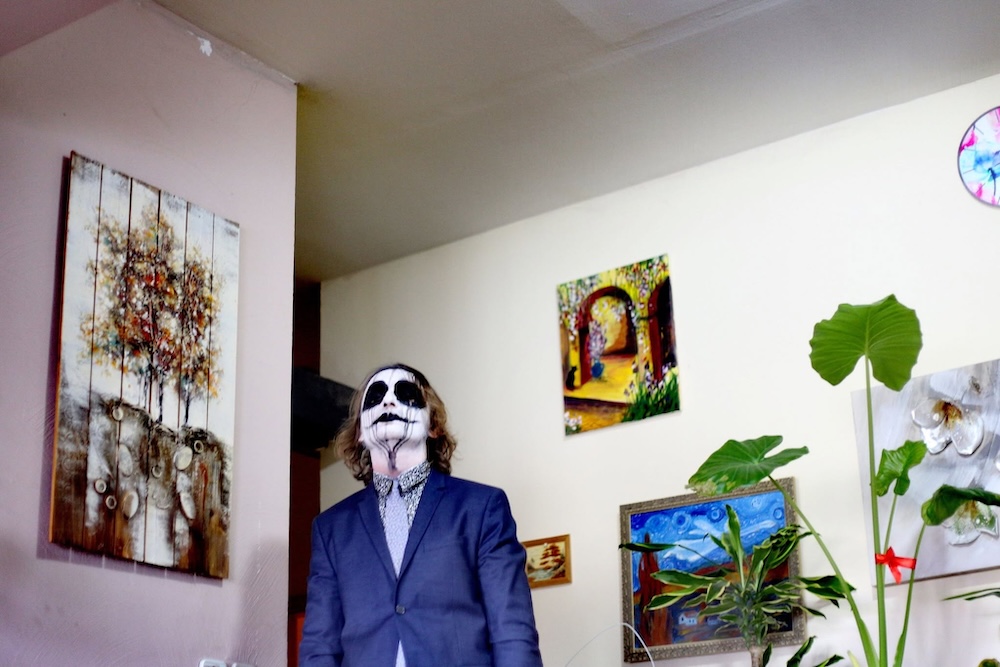
Freidrich$ arrives in corpse paint, surrounded by the visual language of extremity, and gives his album a name that sounds as though it should belong to a black-metal record recorded somewhere in the Norwegian wilderness. The imagery practically invites you to expect distorted guitars, blast beats and an atmosphere of unrelenting menace. Then the music begins, and those expectations quickly start to dissolve – what emerges instead is intimate, funny and disarmingly sincere. Beneath the theatrical darkness is a songwriter far more interested in tenderness, awkward romance and the everyday absurdities of being human than in darkness for darkness’s sake.
There is something wonderfully disobedient about the mismatch, and if the cover makes you expect a heavy-metal record, think again; I Am the Prince of Darkness is, at its core, an indie-pop record through and through, albeit one that has absorbed elements of hip-hop, drill, R&B and lo-fi music along the way. Freidrich$ has constructed an artistic persona that promises darkness while making music that repeatedly reaches toward warmth, yet the contradiction isn’t a flaw in the concept – it is the concept. The corpse paint becomes less a declaration of musical allegiance than a playful disguise, one that makes the softness underneath all the more surprising.
“I was 16, I just thought it was cool,” Freidrich$ says when recalling his early attraction to music, “especially compared to playing sports.” It is an appropriately un-grand beginning for an artist whose current work can involve everything from occult cosmology to acoustic love songs. There was no elaborate manifesto behind the decision to make music in the first place; there was simply the discovery that music offered a more interesting way of inhabiting the world. That instinct toward curiosity rather than allegiance seems to have remained intact.
I Am the Prince of Darkness is a record consisting of 11 songs, containing a surprisingly large number of worlds. Rap, drill, acoustic songwriting, lo-fi production, romantic confession and the iconography of extreme metal are compressed into a small space without being forced into a neat fusion. Freidrich$ doesn’t seem particularly interested in trying to prove that these genres could possibly coexist – in his universe, they simply do. His list of influences explains some of the album’s internal logic: Drake sits beside Lou Reed, Future beside M.I.A.; Ian MacKaye shares territory with Aphex Twin, Burial with Lil Peep, Mayhem with Cat Power.
The closest description may be “twee hip-hop,” although even that phrase only gets halfway there; at its heart, there is the homemade intimacy of indie pop, the melodic instinct of a singer-songwriter and the vocabulary of rap, but none of these elements completely dominates the others. Freidrich$ can sound tough for a few seconds before revealing something sentimental underneath. A boast can suddenly become ridiculous. A joke can unexpectedly become a confession.
“I think in the modern day all new music is basically the same genre,” he says, explaining that he is trying to make music in the mode of how younger people would listen to it. That idea helps explain why the album doesn’t seem particularly interested in maintaining stylistic borders; for a younger listener, the old, stiff divisions between rock, rap, electronic music, pop and underground music feel increasingly dated.
“Enchantment” is one of the album’s clearest demonstrations of this method. The track borrows the machinery of drill without adopting its entire worldview; the beat provides the hard surface, while Freidrich$’s presence introduces something more vulnerable and peculiar.
There is a long history of artists borrowing hip-hop’s aesthetics while remaining fundamentally outside its culture, often producing music that feels like costume. Freidrich$ seems more interested in the opposite problem: what happens when someone genuinely loves the language of rap but refuses to pretend that he belongs neatly inside its traditional archetypes? His answer is to make the awkwardness visible.
That becomes particularly apparent on “Never Get Old.” The references to the projects aren’t presented as a résumé or a declaration of authenticity; they feel closer to memories, fantasies and observations from someone looking at a world that fascinates him without claiming complete ownership of it. The distinction gives the song an unusual emotional quality; Freidrich$ isn’t necessarily telling us, this is who I am. He is asking something closer to, what would it be like to be this person? That curiosity runs through the entire record.
The album’s relationship with rap history is equally playful. “Shimmy Yay,” with its lulling guitars, marks a shift further into the album’s indie-pop influence, allowing the record to loosen some of its harsher edges without losing its personality and revealing a softer, more melodic side of the same peculiar character.
“Yours” is the album’s most revealing song, a simple love song that strips away much of the theatricality and exposes the tenderness underneath. Freidrich$ is aware that these influences are deeply embedded in the way he writes and sings: “You can’t take the R&B or hip-hop out of me.”
Freidrich$ doesn’t ask permission to move from drill to acoustic guitar, from street slang to romanticism, from black-metal imagery to something approaching bedroom pop, and that refusal to explain itself is one of the album’s strengths.
The production follows the same principle; rather than building a polished, unified sonic world, Freidrich$ allows different textures to remain recognizable. Beats can sound skeletal. Melodies can feel homemade. Samples sit beside acoustic instruments. The edges aren’t always sanded down.
That intimacy also makes the corpse paint more interesting; it stops functioning simply as a symbol of darkness and becomes another layer of the character. Freidrich$ seems to understand that an artist can construct an exaggerated persona without necessarily hiding behind it.
The Prince of Darkness isn’t particularly terrifying; he is romantic, occasionally ridiculous, and seemingly determined to be dangerous and loved at the same time. Freidrich$ describes the declaration that he is the “Prince of Darkness” as fundamentally ironic because the music itself is twee, making the grandiosity of the title collide with the modesty, sweetness and awkwardness of the songs. It is an intentionally oversized crown placed on a surprisingly vulnerable head.
Yet the darkness isn’t entirely a joke; the deepest conceptual material on the record emerges through Freidrich$’s interest in situating his own problems and ambitions inside an enormous cosmological framework. Most of the songs on the album remain concerned with recognizably human problems – love, desire, identity, ambition and insecurity – and only “Yaldabaoth” directly engages with the cosmic system.
That separation is crucial to the record’s unusual emotional architecture; Freidrich$ describes his intention as making his own experiences into a microcosm of the larger existential horror of the conspiracy against humanity, comparing the role of personal romance within the album to the relationship between Julia and Winston in 1984.
The analogy reveals what makes the concept interesting: the personal and the cosmic aren’t competing narratives. They are occupying the same space – romance and eschatology can coexist. The private desire to be loved becomes almost defiant when placed against a universe designed to reduce human beings to something easily replaced.
This is also where the symbolism surrounding Lucifer, the serpent and Prometheus enters the picture. On “Yaldabaoth,” Freidrich$ asks whether the snake in the Garden of Eden – the figure who gives humanity the knowledge that brings the curse – really had humanity’s best interests at heart. But he also sees another possible interpretation of the figure, with the Luciferian serpent understood alongside Prometheus, the divine rebel who risks his own existence to give humanity fire, freedom and possibility.
Suddenly the “Prince of Darkness” becomes a much more extraordinary title: darkness isn’t necessarily equivalent to evil; the forbidden can also be the source of knowledge, rebellion can be destructive, liberating or both. Fire can illuminate and burn, the serpent can represent a curse, but also the moment when humanity becomes conscious of its own possibilities.
Freidrich$ takes this symbolism even further through music itself, pointing to the Christian association of the serpent with music and to the imagery surrounding the angel traditionally identified with that designation, whose descriptions have been interpreted through musical imagery. In his own mythology, music becomes part of this ancient tension between creation, rebellion, knowledge and control.
Eventually the cosmic mythology becomes intensely personal again; Freidrich$ describes discovering that the “ever-burning fire of the universe,” which was never created and has always existed, has swept him up in its “cool, cool flame.” It is an appropriately paradoxical image for an album built almost entirely on paradox.
The music is dark but warm, as the Prince of Darkness makes twee songs and drill beats accompany vulnerability. The album’s humor comes from this impossible combination, but it would be a mistake to describe I Am the Prince of Darkness as parody – Freidrich$ clearly isn’t laughing at hip-hop from the outside; his affection for the music is too obvious. That affection is what saves the record from irony.
He can borrow the language of street rap without pretending to have lived every story contained within it. He can use black-metal imagery without making a black-metal album. He can write a love song without abandoning his rap identity. He can talk about cosmic prison planets without turning every song into an occult manifesto. The result is an artist who sounds most convincing precisely when he refuses to sound completely convincing.
In his free time, Freidrich$ enjoys yoga, reading books and spending time in nature, alongside his work in music. The contrast between nature and cosmic horror, physical practice and metaphysical speculation, acoustic guitar and drill production mirrors the album’s larger refusal to settle into a single identity – in that sense, I Am the Prince of Darkness is an album about identity as performance.
Everyone is borrowing something. The rapper borrows the mythology of the gangster. The indie musician borrows the intimacy of the bedroom. The metal musician borrows the mythology of evil. The pop singer borrows the language of romance. Freidrich$ borrows from all of them, while making no attempt to disguise the seams.
That outsider position gives the record its emotional center; Freidrich$ doesn’t need to choose between the prince and the twee kid – he is both.
The result is an album that treats contradiction not as a problem to solve but as a songwriting technique. It can be goofy without being disposable, sentimental without becoming saccharine, and aggressive without requiring a convincing performance of toughness. Most importantly, it sounds like somebody having fun with music.
There is no sense here that every stylistic decision has been made to fit into a neat little box. The songs feel like discoveries; one idea leads to another, and the album follows.
I Am the Prince of Darkness ultimately works because its darkness is never allowed to become a costume that completely covers the person underneath.
The corpse paint is there, the drill beats are there, and so are the serpent and Prometheus. But so are the acoustic guitar, the awkward romance, yoga, books, nature and the unmistakable feeling that underneath the grandiose title is someone who mostly wants to make strange little songs and see what happens.
For all the talk of darkness, this is a record with a surprisingly warm heart.
The Prince of Darkness has arrived, and he brought an acoustic guitar and is ready to sing a serenade.
Listen to I Am the Prince of Darkness on Spotify
About the Author