Ian Roland
In an era when the world feels perpetually on edge, British singer-songwriter Ian Roland crafts music that is both a balm and a wake-up call. His latest single, Some Way of Life, folds raw emotion into a warm blend of contemporary folk, roots, and Americana—what he calls “modern vintage.” The song’s deceptively gentle arrangement carries lyrics born from witnessing atrocities on the news, yet its message transcends a single moment, resonating with anyone who’s ever yearned for understanding in a fractured world.
Roland’s music is shaped by a lifetime of listening—The Beatles, The Kinks, Cat Stevens—and by a collaborative spirit that fuels his work with longtime bandmates Dave Coomber, James Chapman, and Mishkin Fitzgerald. Whether onstage supporting the likes of Martin Simpson or in the studio at Brighton Road, Roland’s goal is clear: to write authentically, connect deeply, and remind listeners they’re not alone.
We sat down with Ian Roland to talk about the origins of his music, the layered meanings behind Some Way of Life, and how he bridges the nostalgic warmth of the past with the urgent themes of today.
How did you initially get into music?
My two older sisters used to play a lot of Beatles so I was listening to that music from an early age, as well as The Kinks and Cat Stevens. We used to have an upright piano which I used to bash about on. I never properly learnt to play piano, which is a shame. I started learning to play guitars instead from about the age of 14.
What inspired you to write Some Way of Life? Was there a specific moment or event that sparked the lyrics and the themes of conflict, resolution, and seeking peace?
Seeing on the ground footage of the genocide in Gaza, on international news programmes, was a trigger. People have interpreted the song to be about personal relationships, climate breakdown, and wars around the world. The song has layers of meaning.
The song has a distinct blend of contemporary folk and Americana influences. How would you describe your musical style, and what do you think makes your approach to Roots-Pop stand out?
My music has been described as modern vintage; indie-folk; contemporary roots. It’s got a hint of a 70’s folk feel but the topics dealt with in the lyrics are current. When we play live, the audience seems to relate to the familiar-but-different-somehow, sounds together with lyrics which relate to their lives.
You’ve said your music combines modern and vintage sounds. In what ways do you think your music bridges the past with the present, both sonically and thematically?
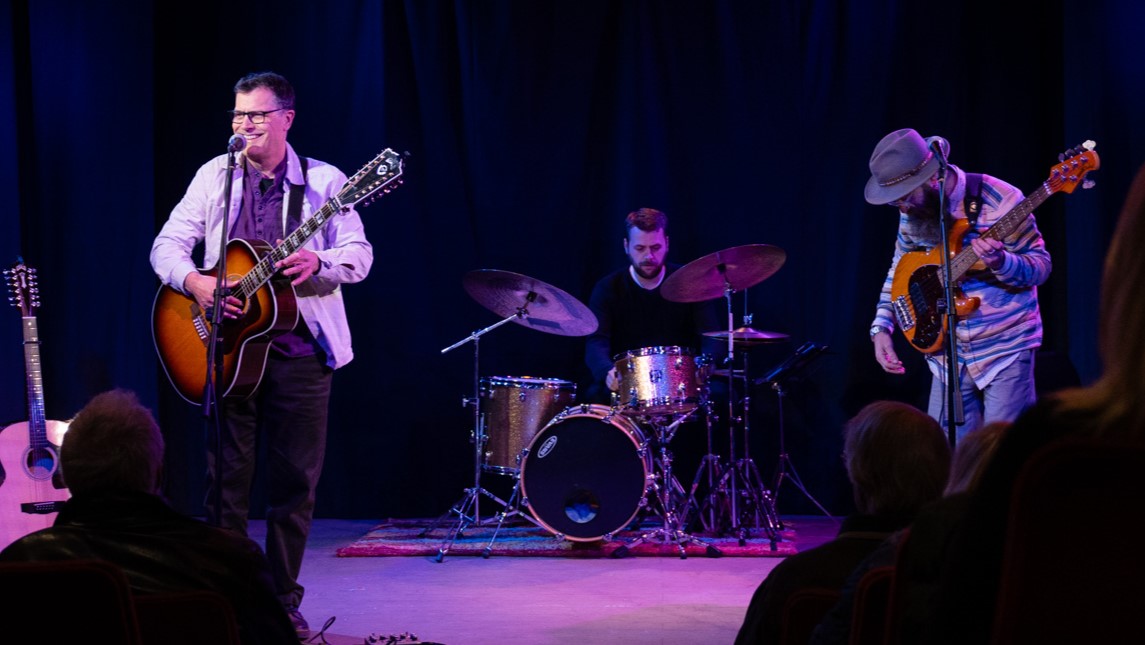
I play Guild 12 string guitars, which have a warmth and earthiness, and add a vintage shimmer. James Chapman’s drum playing has a country americana vibe, as does Dave Coomber’s Music Man StingRay five string bass. Layered on top, is Mishkin Fitzgerald’s upright piano and beautiful gospel-soul backing vocals. Thematically, ‘Some Way of Life’ echoes calls for peace that have been sung for decades…“Must be some way of living, Where you don’t kill me everyday”
The song is a beautiful mix of your vocals, Mishkin Fitzgerald’s piano, and an intricate arrangement. How do you approach collaboration in the studio and with your musicians? What is the creative dynamic like when you work with Dave Coomber, James Chapman, and Mishkin Fitzgerald?
I bring the song to a rehearsal, which I have written with guitar and a single vocal, and we work on adding other instrumentation together, usually one to one. The song evolves in quite a free way with Dave, James and Mishkin working their parts into the melody to enhance it.
There’s a sense of quiet devastation and melancholy in Some Way of Life. How did you balance that emotional weight with the gentle, almost calming musical arrangement?
‘Some Way of Life’ contains rage, deep sadness, frustration, and disbelief that we are so able to hurt each other so completely. The guitar melody came from somewhere trying to hold us together.
The line “Must be some way of living, where I don’t hurt you anymore” has a profound emotional resonance—how do you approach writing lyrics that feel so raw yet also so universally relatable?
The ’Some Way of Life’ lyrics come from a personal reaction to international events in the news and which we all see. I wrote my thoughts down to try to process those events. When I sing the lyrics back to myself, I can see there are layers of meaning and interpretation in the madness and despair I describe. When I sing the song live, I can see others relate to that and something shifts in the status quo. It makes me want to sing the song again.
The song’s instrumentation—especially the piano and guitar—really complement the overall tone. Could you talk a bit about how you approached the arrangement of the track? Were there any specific influences that shaped the sound?
I wanted to keep the song simple, and preserve the guitar melody, so the arrangement reflects that. Influences weren’t conscious ones but would almost certainly include Cat Steven’s ‘Where Do The Children Play’ and The Kinks ‘Waterloo Sunset’, which are songs I have listened to since I first started playing guitar.
Having been described as “soft rock with a folk heart,” your music clearly evokes a sense of nostalgia. Do you find yourself more inspired by the past or the present when crafting new material?
Topics that affect our lives now, inspire me to write songs. Everything and anything I have listened to would probably percolate up, but I am not consciously thinking I need to write in a particular way.
How do you generally approach the songwriting process? Is it a spontaneous, emotion-driven moment, or do you tend to develop ideas more methodically over time?
I have a lyric idea, then I pick up the guitar and muck around with different tunings until I find one that seems to reflect how I am feeling. And then I experiment with chords for ages until the song emerges. It very much happens in the moment and can extend over days.
This track was recorded at Brighton Road Recording Studios with Jake Skinner. How much of the final sound reflects the studio environment and the collaborative process with the producer?
I really enjoy working with Jake at Brighton Road Recording Studios. It’s a high-end studio and the band come well prepared to record as efficiently as possible. James (drums), Dave (bass) and I play the song through and record the feel. That process captures the drums and bass. Then I record the guitars again and then the vocals. We then add in the piano parts that Mishkin records at her own studio and sends to us, along with her backing vocals. Then comes the fun of mixing to get all the parts in balance with each other. Jake and I work together closely on this and it’s where the recording begins to come to life. It’s great fun and very absorbing. You can lose many hours, blissfully lost in the process, if you are not careful.
Your music has been described as “timeless” and full of heart. What does that feedback mean to you, and do you set out to make music that resonates with people in that way?
I try to make music that means something to me first and then, hopefully, it will mean something to others too. I am really pleased when a song resonates with listeners. It means I am not alone, and neither are they.
You’ve had the opportunity to support some incredible artists like Martin Simpson and Boo Hewerdine. How have those experiences shaped your growth as an artist and as a performer?
I have been really lucky enough to support some incredible artists: Martin Simpson, The Black Feathers, Stick In The Wheel, TV Smith, Robb Johnson, Boo Hewerdine, Robert Vincent, Chris Helme, Joshua Ray Walker, Laura Jane Wilkie, 10cc’s Graham Gouldman.
Those support slots taught me how to try and control my nerves and still perform. Shaking with nerves when you are trying to pick a 12-string guitar is frightening but the adrenaline rush when you manage to play the song and reach the other side is very addictive.
The lyrics reflect a deeply introspective perspective on human relationships. How do you balance personal vulnerability with universal themes in your songwriting?
You have to write authentically. You must be ready to be honest. You can’t fake it. When you are honest and authentic, then it’s likely you will be touching upon a universal theme that others can relate to.
Your style has been compared to artists like Paul Simon, Nick Drake, and Fleet Foxes. How do you feel about those comparisons? Do they influence the way you approach your music, or do you prefer to let your sound stand on its own?
I don’t think about trying to sound like someone else. I work on developing my own style of playing and songwriting and then I hope that it draws people in and they want to listen to my music and what I am singing about.
What’s next for you after Some Way of Life? Are you working on any new material, or do you have any upcoming live performances we should look out for?
I recorded eight new songs in February 2025, with the band, at Brighton Road Recording studio. ‘Hang On To You’ was the first release, which I put out in May ianroland.bandcamp.com/track/hang-on-to-you and ‘Some Way of Life’ is the second release ianroland.bandcamp.com/track/some-way-of-life Both these tracks are available wherever you stream your music, as well as on Bandcamp. I will be releasing the remaining six songs as singles over the coming months. You can keep up to date on progress via my website https://ianroland.com I try to play live as much as possible. Gig listing can be found on my website at https://ianroland.com/live/
Is there any advice you would give to emerging artists who are trying to craft their own sound in the current musical landscape?
Play live as much as possible. Try out material at open mics and support your local music community.
Finally, what do you hope listeners take away from Some Way of Life?
That there are
“Storms ahead brewing
Lighting up the same sky
Must be some way of living
Where we’re on the same side.”
Some Way of Life – Ian Roland
Listen to Some Way of Life here.
Check out the official website of Ian Roland.
About the Author