Michaela Rose and Arabesque
From teenage contest winner to fronting one of Europe’s most beloved disco groups, Rose opens up about her incredible career.
With a career spanning over five decades, Michaela Rose has lived a life as dynamic and colorful as the music she created. As a founding member of the iconic disco group Arabesque, she captured international audiences with unforgettable hits and a vibrant stage presence that defined an era. Beyond the spotlight, her journey has woven together multicultural roots, spiritual exploration, and personal reinvention — from global stardom to life coaching and back to music once more. Today, Rose reflects on her extraordinary path, the timeless power of disco, and why, for her, authenticity and gratitude remain the keys to lasting success.
Thank you so much for taking the time to speak with us, Michaela! Your life is quite international, with roots in Switzerland, a German mother, and an Uzbek father. How did this multicultural background influence your music and creative outlook?
My roots are from a German mother and an Uzbek father. As a child, I also lived for two years in Italy. So, I’ve always felt international )) Also, I didn’t really look very German with my Asian eyes and long black hair…
You started your career as a model and worked at a Veruschka boutique before transitioning into music? When did you first realize you wanted to work in show business?
I never worked as a model, but a photographer from a German TV station taught me how to pose for photos.

You won the Young Star Records Starchance ’75 contest, which led to your role in Arabesque. What was that audition experience like, and how did it feel to go from contest winner to a member of a globally recognized group?
I was 15 when I won the contest, and 17 when I was chosen to help form the group Arabesque as a founding member. Since I already knew as a child that I wanted to be a singer or actress, this dream came true.
Arabesque became a sensation with hits like Hello Mr. Monkey and Friday Night. How involved were you in the songwriting process, and what inspired the themes of the band’s most popular tracks? Looking back, what do you think was the key to Arabesque’s immediate success?
We always had a composer, Jean Frankfurter, and John Möring, who wrote all the lyrics for Arabesque songs. I guess the “Happy Sound” and melodic music, combined with our dancing and singing, created the success.
Can you walk us through the early days of Arabesque? What was the atmosphere like in the studio when the first songs were being recorded?
It was always a very professional but friendly atmosphere in the studio. But our producer, Wolfgang Mewes, trained us very strictly to work hard on everything.
In addition to being the lead vocalist, you also handled the group’s fashion and stage outfits. Did you face any challenges balancing music and fashion responsibilities?
At that time, there wasn’t much room for challenges, because we were almost always touring or recording.
You toured extensively with Arabesque across Europe, Asia, and the Far East. Which country or city left the most lasting impression on you, and why?
Definitely Japan! When I first went there, I already felt a little familiar because of my Asian roots. Also, we had tremendous success there — almost everyone knew us. I loved touring in Japan, it’s such an amazing and cultural country.

After Arabesque disbanded in 1984, you formed the duo Rouge. How did that experience differ from your time with Arabesque, especially with the duo’s success in Japan?
With Rouge, there wasn’t as much work or success anymore, because the music had changed. But one special thing was that we recorded a whole album in Japanese — that was a big challenge ))
In the 1990s, you stepped away from the spotlight and became deeply involved in metaphysical naturalism, eventually becoming a Reiki Master and life coach. What sparked this shift in focus, and how has it contributed to your personal growth?
I’ve always been a “seeker” for many questions in my life, and that brought me to spiritual work. After going through some very hard times, I needed answers and help to overcome those situations. Several methods — metaphysical, spiritual, but also psychological — helped me very much. And of course, it shaped my character until today. This kind of reflection never stops!
After nearly two decades, you returned to music with the reformation of Arabesque in 2006. What motivated that decision, and what was it like reconnecting with the music after so many years?
It came out of the blue! One day, a booking agent from Russia contacted me and asked me to rebuild the group. Until then, I didn’t know that Arabesque had also been very popular in the whole former Soviet Union. I thought about it and decided to accept. So I started Arabesque again! With several new members I could choose, I’ve been touring and performing now for almost 20 years as “Arabesque original Michaela Rose.”

Your new song Music Is Always the Key beautifully expresses the unifying power of music. What inspired you to compose and write your first song, and how did you approach the creative process? Also, what was it like working with Eric Roberts in the official music video?
The inspiration came to me after touring with several artists who didn’t speak English, and my Russian is very limited;)) But anyway, we always understood each other by heart and through music — and even our fans do, too. That made me so happy that one night I suddenly woke up with a melody in my head, and later the lyrics came to me. “Music Is Always the Key” was born! Back in Germany, I found a great producer and musician, Jörg Dewald, who composed the music.
As for the video, the Kazakh film director Erken Ialgashev wanted me for his movie, so he contacted my manager and we started working together. We filmed in Kazakhstan, Russia, Dubai, and Los Angeles. With Eric Roberts, I had the honor to film in Los Angeles. It was so exciting working with such a big actor! At the same time, I was shooting my music video, also directed by Erken Ialgashev. Eric heard the song and immediately liked it. He agreed to appear in my music video, too — that was such a big honor!!
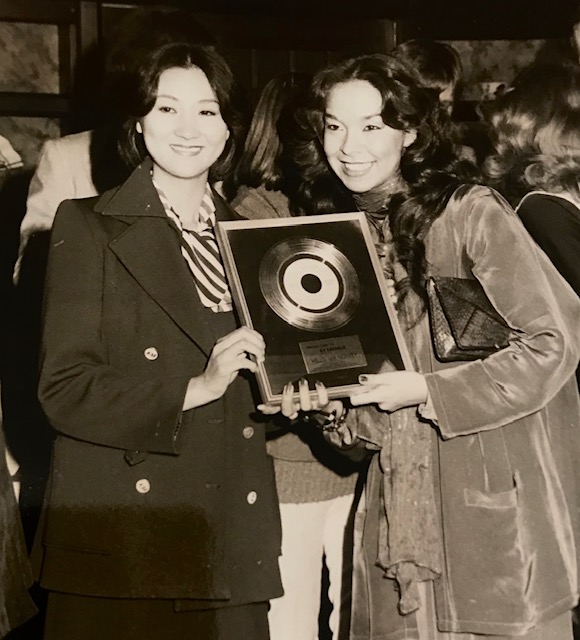
Arabesque’s music continues to resonate with audiences today with timeless hits like Midnight Dancer and Marigot Bay. Why do you think these songs have remained so beloved over the years? Do you still keep in touch with former members, producers, or composers from the group?
Disco music always brings a kind of easiness and happiness — that’s what people still love. When I restarted in 2006, I talked to Jean Frankfurter and my record company, and they supported me directly in everything.
How do you define success today compared to when you started? What’s your take on how the music industry has changed over the years? If you could change one thing about how it operates today, what would it be?
Well, sooooo many things have changed over the years — and not all for the better. The music industry has gone down because of internet platforms that pay only very low percentages. Also, these music casting shows give people the illusion of becoming a “star,” which isn’t helpful. In my time, you wanted to be a singer; today, you want to be a star… whatever that means. It’s all so superficial, and disappears so fast… But there will always be changes, and we have to deal with them.
You’ve had an incredible career that spans both artistic expression and personal growth. What’s next for you?
Just going on with everything!
With your wealth of experience, what advice would you give to young artists starting out in today’s music world?
Try to stay authentic!
Finally, to all the fans who have supported you throughout your journey — what message would you like to share with them?
I’m so thankful and happy that, even after more than 50 years, they still like and remember our music! I appreciate and love all of them, and always try to stay in contact with my fans. Sending a big hug to all of them, and I hope they will stay with me forever. 🙏🏻🌹
Watch the official music video of Music Is Always Tbe Key.
Official website of Arabesque.
About the Author