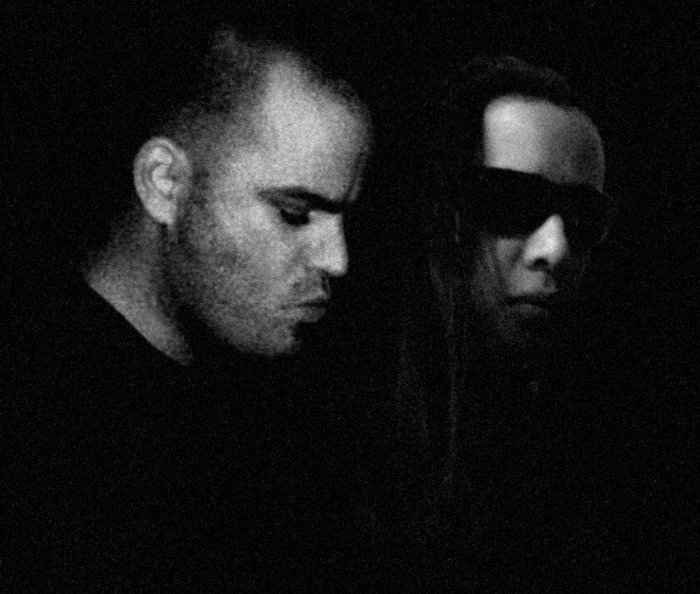
Active Bastard
On their debut album, Ian and Ionas explore hardcore punk through gothic textures and brutally honest songwriting
Active Bastard is the studio collaboration between Ian and Ionas, a duo working across distance and email exchanges rather than the traditional structure of a touring band. Their debut album The Golem takes hardcore punk as its foundation but expands it into a wider emotional and sonic space, drawing in gothic atmosphere and experimental textures without abandoning its raw core. Shaped through a long process of remote collaboration, the record reflects both the intensity and the isolation of how it was made.
Across its runtime, The Golem focuses less on speed and aggression for its own sake and more on psychological weight. Ian’s lyrics move through alienation, dark humor, and personal collapse, while Ionas’ compositions stretch the genre’s boundaries into more cinematic and unpredictable forms. The result is a record that treats hardcore not as nostalgia or revivalism, but as a flexible language for adult disillusionment, emotional volatility, and the quiet distance between people even when they are creating something together.
To start off, can you tell us a bit about yourself, your background, and how you first got into music and punk culture?
I was really into bad metal when I was a kid, and I have an older brother and sister who would say to my mother, “Oh mom, at least it’s not the Sex Pistols.” So around 11, I picked up a copy of Never Mind the Bollocks, and that was my music. I got into hardcore punk a few years later through bands like Black Flag and Agnostic Front. When I got into high school, I joined my first band, and I was just a guy who could yell really loudly, even without a proper PA setup. I do not know how Ionas got into punk music or playing it, as we did not know one another at the time. We played parallel to each other for a while before we really got to know one another.
The Golem feels rooted in hardcore punk, but there are also gothic, metal, and experimental textures throughout the album. Was that diversity intentional from the beginning, or did it evolve naturally during recording?
This project evolved naturally, and it was not intentional. I really wish Ionas was in on this, because at the very beginning we were going to be an Oi! project, and there are a few songs like that on the album, but we wound up encompassing every type of subgenre within punk and even a few outside of it that we wanted to explore. That is primarily on Ionas. I have had the luck of working with a streak of good musicians and songwriters over the last close to 20 years, but Ionas has consistently been the most creative and innovative out of all of them. They listen to a much broader spectrum of music than I do. I listen to goth and post-punk, but hardly any metal, and they have a much higher level of musicality than me. The song they wrote the lyrics to and sang on is gold.
You described Active Bastard as “hardcore reduced to its most private function.” What does hardcore mean to you personally in 2026 compared to when you first got involved in punk?
It is not really about decades; it is about how we have approached this. We are not really a band — it is just me and Ionas. For a while we had a bass player as a sort of session player, Matt Williams, who is an incredible musician, but he got too busy, so Ionas finished the rest of the album’s bass tracks. We are doing this as a studio project. We are not going to play shows. We want people to hear our music, but for us it is about the ritual of someone listening to the album alone in the comfort of their bedroom. I do not think things have changed that much between the early ’90s and now as far as that ritual goes versus seeing live music, except that it is rare for people to buy music in hard-copy formats anymore. That has definitely changed. I spent a lot of money on cassettes and CDs — and I am still an avid buyer of CDs — but now most people just stream things, or if they are a little more ambitious, they download them. There is the vinyl revival and the cassette revival, but I am not sure what either of those look like compared to ’90s CD sales.
“Wheels Of Life” stands out because it stretches beyond straightforward hardcore structures. What inspired that song specifically?
The lyrics of that song are all about alienation — one person’s alienation from everything and everyone in a sort of vague dystopian reality that does not seem that far off, at least to me. Alienation between people is a theme that runs throughout this album, along with some really darkly personal lyrics. As for the music, I do not know where Ionas got the inspiration for it on this song; you would have to ask them. It sounds pretty great to me.
The closing track, “Everything Could Be Wonderful,” feels ambitious and almost cinematic compared to the rest of the record. Why did you choose that song as the album closer?
Because it is ambitious and cinematic. It has a kind of climactic feeling to it. There are a number of songs on the album that stick out from the others, but none so much as “Everything Could Be Wonderful,” so it seemed like the perfect place to close the album. I am not sure where else it would have fit.
There’s a strong sense of dark humor and self-destruction in the lyrics. How much of the writing comes from lived experience versus exaggerated storytelling?
I do have a very black sense of humor, and I am very much into storytelling, but at the same time, when I wrote a lot of these lyrics I was on the verge of suicide, and I do have mental health problems, so a lot of it comes from very real-life experiences as well. I would say “Everything Could Be Wonderful” is not based on any sort of reality, except that I am around the same age as the main narrator and I used to get messed up in the square where the story is set.
You’ve said this isn’t a revival or nostalgia project. What aspects of modern hardcore or punk culture do you feel disconnected from?
For me personally, it is how disposable a lot of it has become. The music, the lyrics — everything just feels completely disposable and devoid of craftsmanship. The thing that initially gets my goat is usually the lyrics. I am not going to name names because I am not really into tearing people down at this point in my life — if you had asked me 20 years ago, it would have been a different story — but there are a lot of bands where it feels like they write lyrics by stringing together as many clichés as possible. The same goes for the music. A lot of it sounds like people are just ripping off the three or four most popular British punk bands from the ’70s and ’80s. In the first question I said the Sex Pistols got me into punk, but you can take influence from that album and still be original musically and lyrically. Bands like The Humpers proved that in the ’90s. Now the tendency seems to be to just imitate those bands outright. The absolute worst for it is the Oi! and hardcore scene — a lot of people with mashed potatoes where their brains are supposed to be cheering on horrifyingly bad bands.
How did the collaboration between you and Ionas come together creatively? Did one person typically lead songs, or was it fully collaborative?
We live in different cities about an hour away from one another, even though we come from the same city, so most of the writing was done via email. Then I would go down by bus or train and spend a few days recording. The writing was definitely done with one person matching music or lyrics to another person’s creation, and it happened both ways. Which way happened more often, I am honestly not sure. That whole time frame is a bit of a blur because it stretched over a long period and we suffered a lot of setbacks, like the COVID lockdowns. It had to be that kind of “match this to that” collaboration because we were doing all the writing over email or Facebook. I will say it was fully collaborative in the sense that, with the exception of one song — “Hate Me Baby,” which Ionas wrote the lyrics for and sang on — Ionas wrote all the music, I wrote all the lyrics, and Ionas produced the album. They would tell me when something was weak, but how something was delivered vocally was pretty much always my idea, and they were great about giving me the freedom to follow through on that. On the other hand, I would say Ionas put a lot more into this album and is much more responsible for how it sounds than I am. Ionas is just a much more talented person than I am, and on top of that, they are much better with computers than me.
The album was picked up by European labels Urban Lurk and No Fuss Tapes shortly after release. Were you surprised by the response overseas?
It was kind of surprising. We tried to get a North American cassette label to put us out, and we went all over the place with no luck, so being approached by an overseas label was a little surprising to me — although maybe not to Ionas, whose last band’s album had been released by a European label. They handle all the communication with the label people, so I do not actually know how our sales are going, and I have no way of knowing who is streaming the album, but yeah, I was surprised by that response.
Since Active Bastard isn’t intended as a touring band, does that freedom change the way you approach songwriting and production?
There is a ton of freedom in it for us musically. I mean, if Ionas wanted to layer 100 guitars, they could. I do not know if I would put it entirely in those terms, though. I do not feel like I am the best lyricist in the world, but I at least want to write lyrics that are relevant to someone in their mid-40s. I do not write political lyrics, and we are not a political band. There is social commentary throughout the record, but I write more personal material, and I want to write from the perspective of a guy in his mid-40s who has mental health problems. I do not want to write from the perspective of a teenage kid getting drunk and raging because of hormones and youth. I already did that, and it was fun, but I am older now.
A lot of hardcore records aim for aggression, but The Golem also feels melancholic and reflective. Was capturing that emotional balance important to you?
I do not think we hold out any hope on this album. The title of that song is kind of ironic — the song ends horribly.
The album description mentions “zero patience for optimism,” yet the title “Everything Could Be Wonderful” suggests the opposite. Is there genuine hope buried somewhere in the record?
I do not think we hold out any hope on this album. The title of that song is kind of ironic. The song ends horribly.
What records, books, films, or life experiences most influenced The Golem?
I really wish Ionas was here for this, but from my side of things, Black Flag’s First Four Years and Damaged, Sheer Terror and Joe Coffee’s discographies, and Poison Idea’s discography — especially Feel the Darkness — had a profound influence on me lyrically. The Germs and Slapshot also had a big impact, though more musically than lyrically. Jack Kelly kind of has the perfect hardcore voice. Those are the big hardcore influences. Beyond that: UK Subs’s Another Kind of Blues, The Humpers’ Plastique Valentine, Joy Division’s Unknown Pleasures, and The Birthday Party’s Hits. I do not really watch many movies, and at one point I was a big reader, but that has dropped off. I watch a lot of news, which is terrifying and sometimes comedic at the same time, but I digress. Different life experiences were instrumental in shaping the lyrics on this record. I was on the verge of suicide when a lot of it was written, so that definitely impacted many of the lyrics. “Boring Bitter,” “Ugly,” and “Disconnect” are all very autobiographical for me. The feeling of alienation that runs throughout the record is, I would argue, something societal throughout the Western world — maybe even beyond that — but it is something I personally live and feel. Even the material that is pure storytelling, like “Everything Could Be Wonderful,” draws from real life. The narrator is my age, in a similar economic position to me, and the story takes place in a memorial square in the city I live in where I used to hang out after dropping acid as a teenager. So I would say the record draws heavily from lived experience.
Do you see Active Bastard as an ongoing project, or was The Golem created as a self-contained statement?
No, the plan is to do another album, but whether it goes past that remains to be seen. Ionas is already hard at work on an electropop solo project that will get them performing live again, and I am in the very early stages of an industrial band, which is exciting for me because I have never really done anything outside of hardcore and one Oi! band. I also want to start another hardcore band, but more in the style of West Coast hardcore, which is actually what I grew up on and where I think my vocals could still grow a little. So the next Active Bastard album probably will not come together for quite a long time. I think we know what direction we are heading in, and there are hints of it on The Golem, but it will be a totally different album.
For listeners who might not usually connect with hardcore punk, which track would you want them to hear first and why?
“Everything Could Be Wonderful,” because it has a hardcore feel while also having so many riffs and such grandiose lyrics. I am not much of a singer, but the narrative style of the vocals is different from some of the more aggressive songs on the album. So if someone is more used to polished music, that is probably the track I would point them toward first.
What do you hope people misunderstand the least about this project?
For me personally, I really hope people pick up on the fact that there is more going on in the lyrics than just the obvious personal tragedies in the storytelling. I also do not want to be accused of whining — that was just a portion of my life I was documenting.
About the Author