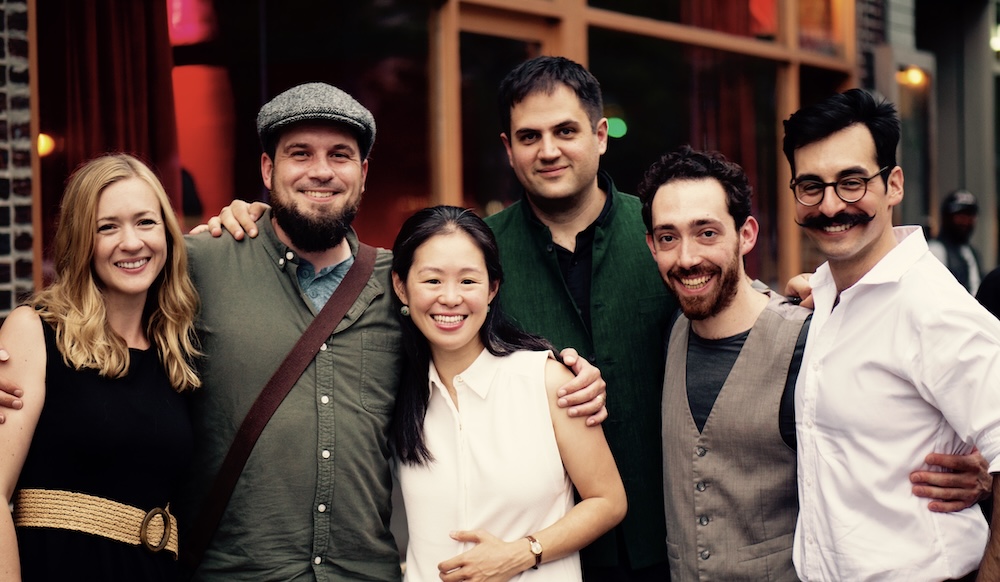
Floyds Row
An Oxford-Born Collective Exploring the Connections Between Early Music, Folk, and World Traditions
Somewhere between a medieval manuscript, an English village dance, a New York rehearsal room, and a Mediterranean rhythm circle exists the unlikely musical universe of Floyds Row.
The folk collective explores the connections among early music, classical, folk, bluegrass, newgrass, and world traditions, creating a musical language in which centuries-old melodies can exist alongside contemporary rhythms, improvisation, and original composition. Their music does not treat genres as isolated territories. Instead, Floyds Row looks for the places where they overlap—where an old English tune can reveal an unexpected relationship with a modern folk song, where a Renaissance melody can find new life through improvisation, or where European historical traditions can meet the sounds of the Middle East and Eastern Mediterranean.
As multi-instrumentalist Andrew Arceci explains, Floyds Row is not simply an early music ensemble, as historical repertoire is merely one element within a much broader musical landscape.
“What connects these seemingly different worlds is that we’re interested in music as something living and evolving, rather than a collection of fixed categories,” Arceci says. “The labels—early music, folk, Americana, roots, traditional—can be useful, but they don’t fully describe the range of what we’re doing.”
That idea sits at the heart of Floyds Row’s identity—their work begins with curiosity rather than classification. The group follows melodies through time, examining how songs migrate between communities, how traditions absorb new influences, and how musicians across generations reshape inherited material.
The result is music that feels like a discovery—but it is not a recreation. Floyds Row is not trying to place old songs behind glass or preserve them in some imagined historical purity. They are interested in what happens when forgotten melodies are allowed to breathe again: when a centuries-old ballad meets improvisation, when a baroque violin converses with Middle Eastern percussion, when a Renaissance dance becomes something emotionally immediate for a listener in the twenty-first century.
Their newest release, The Carlisle Sessions, continues that journey. The album brings together traditional ballads, historical dance music, and newly created material, reflecting the ensemble’s belief that the past is not a finished chapter but an ongoing conversation.
For Floyds Row, the question is not whether a piece of music belongs to the past or the present. The question is what happens when those boundaries disappear.
Floyds Row’s origins reach back to Oxford, where a series of concerts at the University of Oxford brought together performers fascinated by the meeting point between early music and living tradition.
Composer and scholar Chris Ferebee organized the initial collaborations, working with musicians including Alistair Anderson, Andrew Arceci, and various guest performers. What began as a series of experimental concerts gradually developed into a collective with its own distinctive musical identity. The experience eventually led to the group’s debut recording, The Oxford Sessions, released on Centaur Records.
Even the group’s name carries a sense of place: Floyds Row is a small street off St Aldate’s in Oxford, located near the University of Oxford’s former Faculty of Music site, making it an appropriately unusual point of origin for a project built around creative intersections.
From the beginning, Floyds Row’s interest in historical music was never simply about reproducing the past, the musicians wanted to understand how music changes—how melodies travel, how traditions absorb influences, and how performers transform inherited material.
Their members include specialists in historically informed performance, including soprano Emily Noël, violinist Asako Takeuchi, and Andrew Arceci, who work with period instruments, historical approaches, and repertoire from the Renaissance, Baroque, and Classical eras. Yet Floyds Row deliberately avoids being defined as a historical performance ensemble.
As Arceci explains, the group uses historical material as a starting point rather than a final destination.
“We’ll include historical material as a starting point, but we’ll reshape it through our experiences, influences, and musical languages,” he says. “In some ways, that’s actually part of the historical tradition itself. Music has always changed as it moved from one musician, community, culture, or generation to another.”
A folk song rarely has a single definitive version, it survives precisely because people continue to transform it. Improvisation therefore becomes not a departure from tradition but a continuation of it.
Musicians of earlier centuries were not simply performers reproducing fixed scores—they ornamented melodies, created variations, responded to harmonies, and adapted pieces to new circumstances. Floyds Row sees a direct connection between that historical practice and the freedom found in jazz, folk, and world music today.
“Improvisation is not a modern invention,” Arceci explains. Earlier musicians developed sophisticated approaches to ornamentation and variation, using creativity as an essential part of performance rather than an exception.
Accordionist and pianist George Lykogiannis describes improvisation as something that exists throughout Floyds Row’s entire creative process.
“Improvisation is very important to Floyds Row, as it permeates much of the music we play, and touches almost every part of how we put a piece together.”
Sometimes that means melodic ornamentation, drawing from Baroque and world traditions. Sometimes it means extended solos. Often it means building arrangements from minimal information—perhaps only a melody, chord symbols, or fragments of historical material—and discovering the final shape through experimentation.
For Floyds Row, improvisation gives historical music back its sense of movement.
“By breathing that extra bit of life into the piece using improvisation,” Lykogiannis says, “it gives us a sense that the past was as rich and vibrant a place as the world today.”
That philosophy is reflected in the musicians themselves. Floyds Row brings together artists whose individual careers span early music, classical performance, folk, composition, ethnomusicology, jazz, dance music, and world traditions.
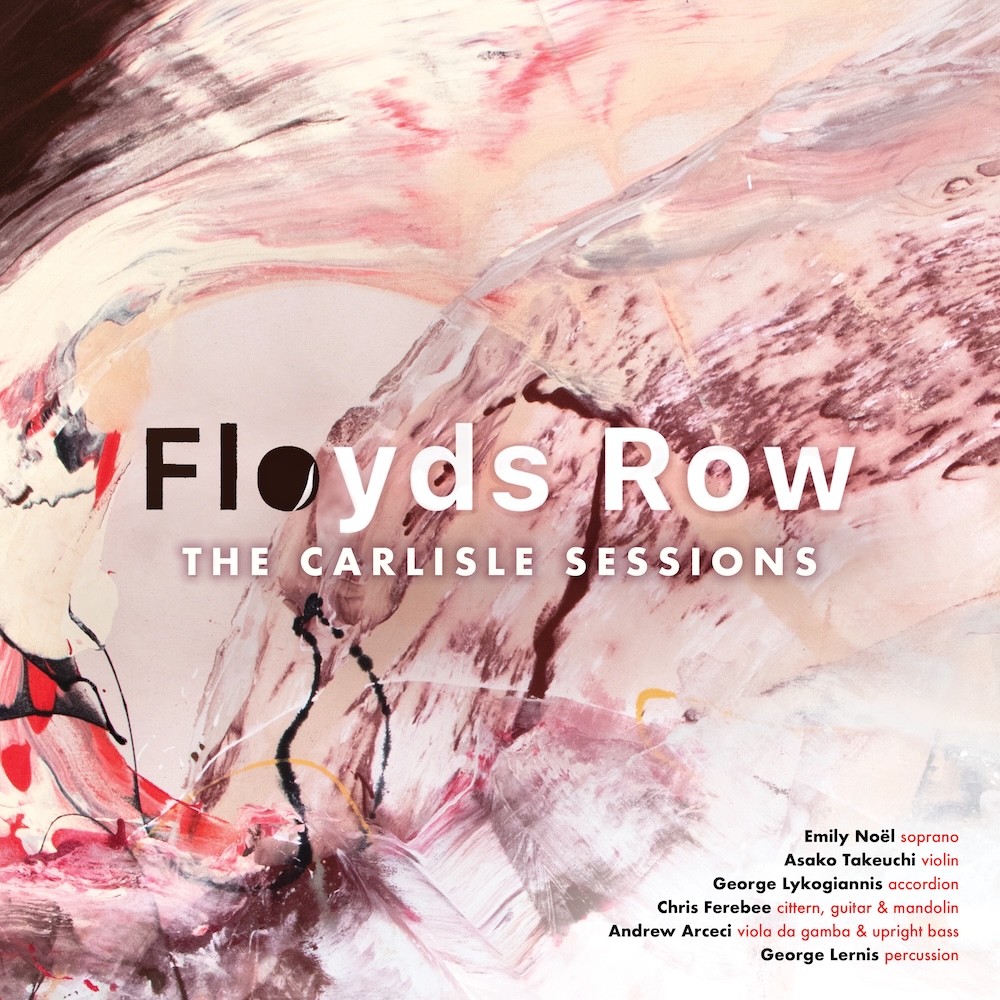
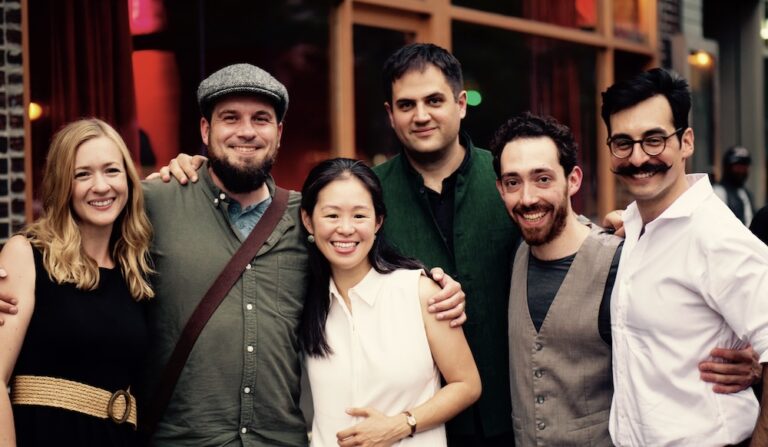
The ensemble featured on The Carlisle Sessions includes soprano Emily Noël, violinist Asako Takeuchi, accordionist George Lykogiannis, composer and multi-instrumentalist Chris Ferebee, percussionist George Lernis, and Andrew Arceci on viola da gamba and upright bass. The album captures the particular chemistry of this six-member configuration, recorded during a period when the group’s musical identity had already taken shape.
For Floyds Row, the diversity of its members is not something to be blended away. It is the source of the ensemble’s character.
“The different backgrounds of the six musicians are a huge part of Floyds Row’s sound,” Andrew Arceci explains. “Everyone brings a different musical vocabulary, whether that’s rooted in early music, classical performance, folk, bluegrass, jazz, world music, or something else. These differences aren’t something we smooth over—we showcase them.”
Soprano Emily Noël brings a voice shaped by both historical vocal traditions and contemporary performance. Her background connects opera, early music, and American folk culture. Growing up in the Washington, D.C. area, she was surrounded by bluegrass traditions, including the music of groups such as the Country Gentlemen and the Seldom Scene, before later studying opera and early music at Peabody, where she met Andrew Arceci.
That journey between traditions mirrors Floyds Row itself. Her voice can move from Renaissance repertoire to traditional ballads while maintaining the emotional directness that makes old songs continue to resonate.
For Noël, historical music is not distant or abstract. Behind every surviving melody are human experiences that remain familiar.
“These composers were simply human beings experiencing human emotions,” she says. “Ideally, the listener stops thinking in terms of ‘old music’ and ‘new music’ and instead hears music reminding us that human stories never grow old.”
Violinist Asako Takeuchi brings the perspective of a Baroque specialist while also embracing the freedom of folk interpretation. Her understanding of historical performance practice gives Floyds Row a connection to centuries-old repertoire, but her approach avoids turning tradition into a museum object.
For Takeuchi, the survival of these melodies is itself proof of their importance.
“I hope that our listeners will find some comfort when hearing these centuries-old tunes, by realizing that good things remain forever appreciated in this fast-changing world,” she says.
Accordionist and pianist George Lykogiannis expands the group’s sound through his background in composition, improvisation, and New York’s vibrant artistic communities. His instrument creates a bridge between folk dance traditions, European musical history, and contemporary rhythmic approaches.
Multi-instrumentalist Andrew Arceci represents another important connection within Floyds Row: the relationship between scholarship and performance. His work with viola da gamba and upright bass reflects both historical expertise and a practical understanding of how musical traditions evolve.
Together, the musicians create an ensemble where knowledge does not create distance from the music. It creates freedom.
The group’s first recording, The Oxford Sessions, introduced the musical philosophy that continues to define Floyds Row. Emerging from concerts organized at the University of Oxford, the project developed into a collective dedicated to exploring connections between historical repertoire, folk traditions, and contemporary expression.
The album demonstrated that music from different centuries does not need to compete for attention. A Renaissance melody, an English folk ballad, or an American dance tune can exist in the same artistic space when musicians approach them with curiosity rather than strict categories.
For Floyds Row, every tradition was once contemporary.
Every melody that survives was once new. Every folk song began with someone making a creative decision—changing a rhythm, adapting a phrase, adding a variation, or carrying a song from one community into another.
That realization shapes the ensemble’s entire philosophy.
A melody from several centuries ago does not remain alive because it was perfectly preserved. It survives because musicians continued to interact with it.
The group’s performances throughout the United Kingdom and United States have reflected that approach, appearing at cultural institutions, universities, festivals, and concert venues including the American Folk Art Museum, Berklee College of Music, Club Passim, King’s Chapel, New Deal Cafe, Rockwood Music Hall, and the Winchendon Music Festival.
Their programs move naturally between traditional pieces, historical dances, original compositions, and arrangements influenced by bluegrass, newgrass, classical, and world music.
The purpose is not simply to create unusual combinations. It is to reveal relationships that have always existed beneath the surface.
A centuries-old English melody and a contemporary folk song may express the same longing. A dance rhythm from one culture may illuminate a forgotten connection in another. A historical instrument may discover an entirely new voice when placed in a modern musical environment.
These discoveries are what drive Floyds Row.
Movement is not only a theme within Floyds Row’s repertoire, it is part of the ensemble’s own existence. The musicians rarely live in the same place. Some work internationally, some live across different countries, and their careers constantly move between communities and traditions.
As Emily Noël explains, that sense of movement has shaped the group’s identity from the beginning.
“Movement is absolutely integral to Floyds Row. It isn’t merely a theme in our repertoire; it’s part of how the group came into being.”
Andrew Arceci and Asako Takeuchi live in Japan, Noël directs opera in France, and the members maintain careers that extend across different musical worlds.
The group therefore does not function as a traditional fixed touring band, instead, Floyds Row has developed into a flexible collective that can appear in different configurations depending on the project.
They have performed as three, four, five, or all six musicians, while maintaining the same artistic identity.
“There’s something naturally nomadic about our sound,” Noël says.
That nomadic quality is reflected in the repertoire itself. Songs travel. Stories migrate. Melodies cross borders.
The ensemble’s music becomes a record of those journeys.
The Carlisle Sessions continues Floyds Row’s exploration of forgotten and transformed musical traditions. The recording brings together traditional ballads, historical dance music, and storytelling traditions, revealing how old material can become emotionally immediate again.
Recorded in Carlisle, Massachusetts, the sessions capture a moment when the ensemble’s identity was already fully developed. Rather than presenting historical pieces as static artifacts, Floyds Row approaches them as living works that can continue to evolve.
The album’s repertoire reaches across centuries of storytelling, including songs connected with adventure, love, conflict, travel, and legendary figures such as Robin Hood.
The musicians are not searching for a mythical “pure” version of the past. They are interested in the creative energy that allowed these songs to survive.
For Floyds Row, an old melody is not a fossil. It is a living organism.
Floyds Row’s approach to historical material is ultimately based on a simple idea: tradition has never been static.
Songs change as they travel. Melodies migrate across borders. Lyrics are rewritten. Instruments disappear and return. Rhythms are transformed. Musicians borrow from one another, sometimes knowingly and sometimes without realizing it.
The collective embraces that process rather than attempting to stop it.
When Floyds Row discovers an old melody, the question is not simply whether it can be accurately reconstructed. The musicians ask what gives the piece the power to survive.
As George Lykogiannis explains:
“If the melody, lyrics, or history are powerful enough, we’ll try pushing that even further.”
The group looks for the emotional core of a song—the element that allows it to remain meaningful across centuries—and then explores how that core can speak through new musical languages.
This approach reflects a larger understanding of creativity: the new is often created by reassembling what already exists.
Andrew Arceci compares this process to transformation rather than replacement.
“Often, ‘the new’ is simply ‘the old’ reassembled,” he says.
For Floyds Row, nothing is truly lost, musical ideas continue changing shape, carried from one generation to another.
That perspective explains why their performances feel less like historical reconstruction and more like archaeology conducted by working musicians. They dig through layers of musical history, uncover forgotten connections, and ask what these discoveries might become.
Floyds Row’s journey is now moving beyond its original Oxford and American performance circuits.
The ensemble’s expanding identity reflects the way the group itself has developed: not as a traditional fixed touring band, but as a flexible artistic collective able to adapt to different projects and locations.
As Andrew Arceci explains, Floyds Row has embraced a more open structure.
“As the collective evolved, the identity has become more flexible. We have principal artists, along with a broad network of guest artists with whom we collaborate, allowing the ensemble to take different shapes while still retaining a shared artistic identity.”
This flexibility has allowed the musicians to balance international careers, university commitments, other ensembles, and family life while continuing to create ambitious projects.
Rather than limiting the group, the changing structure has expanded its possibilities.
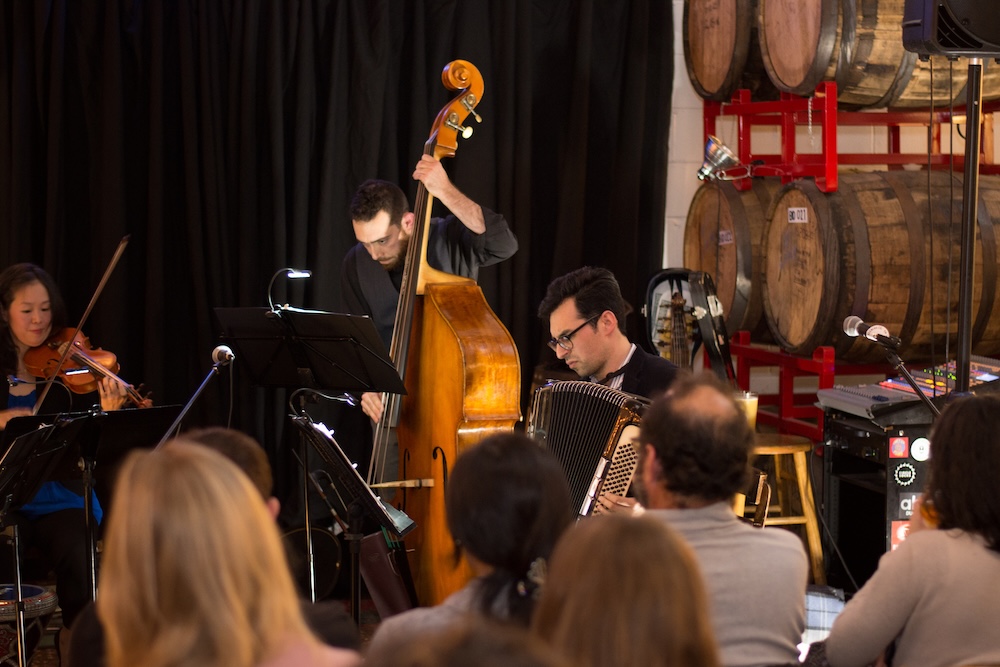
The ensemble is scheduled to travel to Singapore in October 2026, where the project will include several lecture-recitals, bringing Floyds Row’s combination of historical research, performance, and creative reinterpretation to a new audience.
The group will then return to the United States for a March 2027 tour featuring singer-songwriter Chris Moyse, with performances currently scheduled for:
March 6, 2027 — ASU Kerr, Scottsdale, Arizona
March 10, 2027 — Winchendon Music Festival, Winchendon, Massachusetts
March 12, 2027 — Cultural Center of Cape Cod, South Yarmouth, Massachusetts
March 13, 2027 — Harmony on the Green Coffeehouse Concerts, Lexington, Massachusetts
These performances continue Floyds Row’s mission of bringing historical material into direct conversation with contemporary audiences.
The growing international schedule reflects the broader story of the ensemble itself: a project that began with Oxford collaborations and developed into a worldwide musical conversation.
Ultimately, Floyds Row is not interested in creating a division between old music and new music.
They are interested in showing that the distinction is often artificial.
A song from five hundred years ago was created by people who experienced the same emotions that shape music today: love, grief, celebration, loneliness, hope, conflict, faith, and longing.
Emily Noël believes that one of the most important parts of performing historical music is restoring that human connection.
“These ‘old’ songs were created by real people responding to love, grief, faith, longing, celebration, and the world around them, just as musicians do now.”
For Noël, the goal is to help listeners move beyond the idea of historical music as something distant.
The composers, singers, and musicians of previous centuries were not symbols from another world. They were people trying to express something meaningful.
That human quality is what allows the music to survive.
Asako Takeuchi sees the continued life of these melodies as evidence of their enduring value.
“In the modern world, it seems like everything comes and goes quickly, but these tunes are proof that good art forms stay while adapting to each era.”
For Floyds Row, tradition survives not because it remains unchanged, but because it continues to evolve.
A brilliant artist can make us experience something familiar in a completely different way.
That is the space where Floyds Row operates.
They take melodies that may have traveled through centuries, cultures, and countless interpretations, and they reveal new possibilities hidden inside them.
Andrew Arceci describes this as the ensemble’s central artistic goal:
“We’ll take an old tune, experiment with ideas, and reassemble it in a way that allows people to hear something familiar, or perhaps something they thought they knew, anew.”
Their music exists somewhere between preservation and reinvention.
It respects history without becoming imprisoned by it. It draws from folk traditions without treating them as untouchable. It welcomes classical technique, newgrass energy, world rhythms, contemporary composition, and improvisation into the same musical conversation.
A folk song is not a fossil.
A melody is not a monument.
A tradition survives because each generation finds something inside it worth carrying forward—and then discovers its own way of expressing it.
That is what Floyds Row does: they take music that has traveled through centuries and allow it to travel further. The past enters the room, but it does not stay in the past. It moves, shifts shape, and finds new listeners. And in the hands of Floyds Row, centuries-old music is bursting again with energy.
Official website of Floyds Row.
About the Author